FOSS Face-Off: Open Source Music Making with Skred
Most software synthesizers hide their internals behind a polished interface. Skred does the opposite: it is a polyphonic wavetable synthesizer you drive with short ASCII commands typed into a terminal, sent over a network, or played from a MIDI controller — and it is MIT-licensed, open source, and genuinely hackable.
Written in Zig and C by Joseph Stewart (octetta), Skred runs on Linux, macOS and Windows. Instead of the fixed signal paths found in most soft synths, it treats voices like building blocks: route nearly anything to anything, and reshape the sound while it plays.
What Skred Actually Is
Modular voice routing
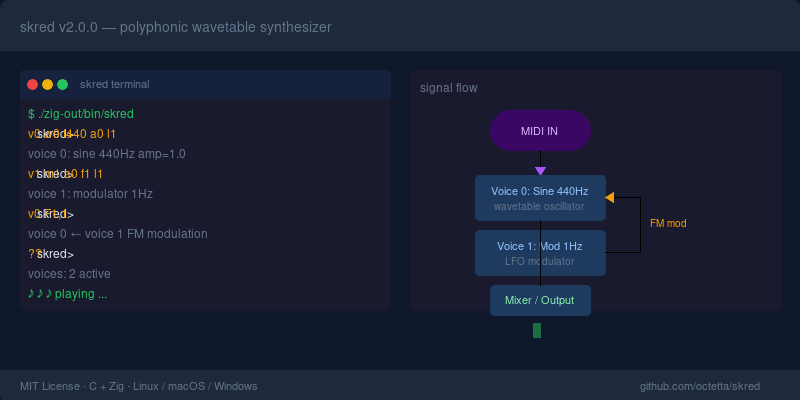
Voices in Skred are not locked into a hardwired architecture. Any voice can drive another — an oscillator can modulate a filter, a low-frequency oscillator can shape a wavetable position, and the routing can be rewired live without stopping playback. That modular playground is the core design decision, and it is what separates Skred from preset-driven instruments.
The Skode live-code language
Control is deliberately terse. Skred’s command language, Skode, is a stream of short ASCII instructions. The same messages work whether you type them into the console, send them over UDP, or generate them from a script — which makes Skred scriptable in a way most synths are not.
v0 w0 f440 a0 l1    # start a 440Hz sine wave on voice 0
v1 m1 a0 f1 l1      # start a 1Hz modulator on voice 1
v0 F1,1             # use v1 to modulate v0’s frequency
??                  # list the running voices
That is not a configuration file. That is how you play it — while the audio is running.
MIDI-aware, with a drum machine construction kit
Recent versions added proper MIDI awareness, which turns Skred from a curiosity into an instrument you can drop into a real setup: connect a hardware controller, a sequencer or a DAW, and Skred responds. It can also act as a drum machine construction kit, building rhythm engines alongside its synth voices, with simple pattern playback that keeps grooves running while you manipulate parameters live.
Honest about the trade-offs
The author is refreshingly blunt that Skred “skips ultra-polished features like pristine interpolation in favor of raw responsiveness and real-time control.” If you want a glossy preset browser, this is not it. If you want to shape sound at the code level, it very much is.
Getting Started
Skred ships precompiled binaries for each architecture, alongside the full source. Building from source needs Zig 0.13.0:
git clone https://github.com/octetta/skred
cd skred
zig build
./zig-out/bin/skred
The latest release is v2.0.0, published in March 2026, and the repository has accumulated around 452 commits — enough history to show this is a maintained project rather than a weekend experiment. Documentation lives at octetta.github.io/skred, covering the synth engine, the Skode language and the helper tools.
It is listed in our directory: Skred.
Where Skred Fits in the Open Source Music Stack
Skred is not trying to be Ableton Live or FL Studio, and it does not need to. The open source music ecosystem is already strong on recording and editing — Audacity for audio editing, Ardour as a full digital audio workstation — and it is increasingly strong on instruments.
Depending on how you like to work:
- Skred — terminal-driven wavetable synth with modular routing and MIDI support
- Helm — a polished graphical polyphonic synth that runs standalone or as LV2, VST, VST3, AU and AAX
- LMMS — a complete workstation with several built-in synth engines
- Sonic Pi — a live-coding music environment, and the friendliest entry point to code-driven sound
- MuseScore — for when your starting point is notation rather than synthesis
Pure Data and ChucK occupy adjacent territory — visual and text-based audio programming respectively — and Skred’s author cites both, along with the Atari POKEY and Commodore SID sound chips, as inspiration.
Why This Matters Beyond One Synth
Skred is one example of a wider trend: creative tools that were once the exclusive territory of paid, closed software now have open counterparts that are not merely adequate substitutes. The pattern repeats across categories — Krita against Photoshop, Blender against Maya, Jellyfin against Plex — and the open alternatives increasingly win on something the closed ones cannot offer: the ability to read the source, modify the tool, and own the result.
Skred will not replace Ableton for everyone, and that is beside the point. What it offers is the freedom to dig into the engine, script the instrument, and build sounds from a terminal if that is how you think about sound.
Explore More
Browse our full directory of free and open source tools for more music production software, including Audacity, Ardour, Helm and Sonic Pi.
Using an open-source synth we have not listed yet? Suggest it for the directory and help other musicians find it.