FOSS Face-Off: EspoCRM vs Twenty vs Krayin — Best Self-Hosted CRM Compared
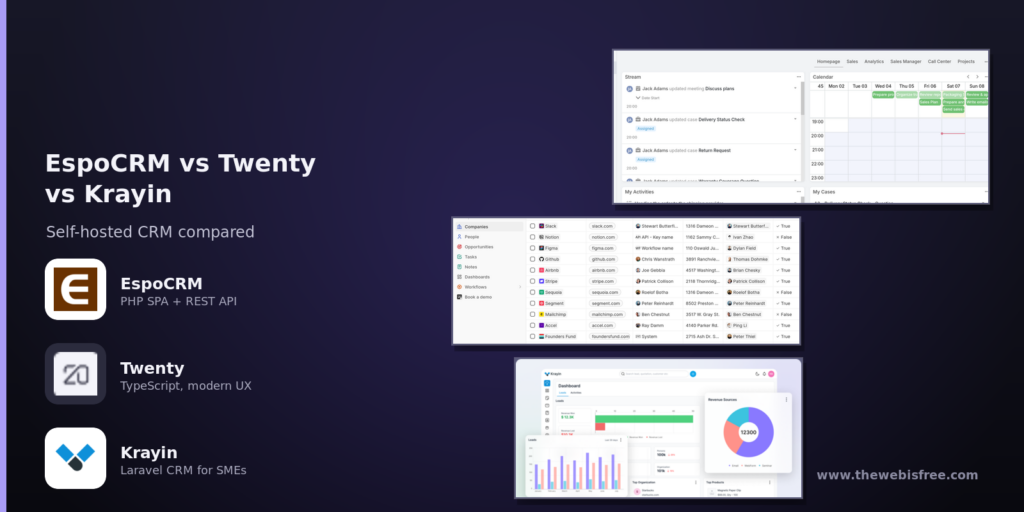
Your CRM holds the most commercially sensitive data a small business owns: every lead, every conversation, every deal you lost and why. Handing that to a SaaS vendor means renting access to your own customer history and paying per seat for it. A self-hosted CRM flips that — the database sits on hardware you control, and the bill does not grow every time you hire.
Three open source CRMs come up again and again for teams that want to own that data. They overlap on the basics, but they suit different organisations. Here is how they compare.
1. EspoCRM — The Established Workhorse
EspoCRM is the veteran of the group: a PHP application with a single-page frontend and a REST API backend, distributed under the AGPL-3.0 licence. The current release is 10.0.11 (23 October 2026), and the project has shipped steady major versions for years rather than chasing a redesign every season.
The selling point is breadth: leads, contacts, accounts, opportunities, campaigns and support cases in one interface, with a workflow engine, a report builder and a roles system that expresses real permission models. The dashboard is built from rearrangeable dashlets, so a sales manager and an agent each get a home screen that fits their job.
- Stack: PHP 8.3-8.5, a single-page frontend, and a REST API for everything the UI does.
- Database: MySQL 8.0+, MariaDB 10.6+ or PostgreSQL 15+ — pick what your team already runs.
- Extensible: entities and fields can be added from the admin UI without touching code.
- Community: roughly 3.5k GitHub stars and a mature extension ecosystem.
2. Twenty — The Modern, Developer-Facing CRM
Twenty is the project that made “open source Salesforce alternative” sound credible. It is TypeScript throughout: a NestJS backend with PostgreSQL and Redis, a React frontend, self-hosted with Docker Compose. With around 60k stars it has the largest community of the three, and the cadence is fast — v2.56.1 landed on 5 November 2026.
Its philosophy differs: Twenty treats the CRM as building blocks you shape — customisable objects and fields, configurable views, and a CLI that scaffolds apps on top of the data model. If your team writes code and wants a CRM that behaves like the rest of the stack, this is the one built on that assumption.
- Stack: TypeScript, NestJS backend, React frontend, PostgreSQL and Redis.
- Licence: AGPL-3.0 for the core, with a few files marked Enterprise under a separate commercial licence — worth reading before planning a fork.
- Self-hosting: an official Docker Compose path plus local setup docs for contributors.
- Community: the largest of the three by an order of magnitude, with an active Discord.
3. Krayin — The Laravel CRM for SMEs
Krayin is built on Laravel and Vue.js and licensed MIT — the most permissive licence here, with no enterprise carve-outs. It targets small and medium businesses that want a conventional CRM: leads, quotes, activities, email, and a clean admin panel rather than a platform to build on. The latest release is v2.2.8 (6 November 2026), with about 24k GitHub stars.
Being a Laravel package, the codebase is familiar to PHP developers. The official requirements are modest — PHP 8.2+, Composer 2.5+, MySQL 8.0.32+, Apache or NGINX, around 3 GB of RAM — so it runs comfortably on a small VPS.
- Stack: Laravel (PHP 8.2+) with a Vue.js frontend.
- Licence: MIT — fork it, rebrand it, embed it in a commercial product if you want.
- Footprint: the lightest of the three to run.
- Fit: teams already using Laravel who want a CRM matching their existing conventions.
Head-to-Head Comparison
Licence. Krayin’s MIT is the most permissive by a wide margin; EspoCRM is AGPL-3.0; Twenty is AGPL-3.0 with a few Enterprise-licensed files. If you intend to redistribute a modified CRM inside a product, that difference matters more than any feature list.
Hosting footprint. Krayin asks for PHP, Composer and MySQL. EspoCRM asks for PHP plus one of three databases — flexible if you already run PostgreSQL, but you still serve it yourself. Twenty is the container-native option, on PostgreSQL and Redis your platform team probably already operates.
Extensibility and API. EspoCRM exposes a complete REST API and lets non-developers add entities and fields from the admin UI. Twenty expects developers and rewards them with a TypeScript codebase, a CLI and app scaffolding. Krayin extends the Laravel way — familiar, but not a no-code exercise.
Ecosystem and community. Twenty’s community is the largest and its releases the fastest — which also means more churn. EspoCRM is the most mature; Krayin has the smallest community but a stable core.
Migration path. All three import from CSV and expose their data over APIs, so leaving a SaaS CRM is a project rather than a rewrite — and keeping the data in your own database makes the next move a query, not a support ticket.
Which One Should You Pick?
Choose EspoCRM if: you want a proven, feature-complete CRM with workflow automation, granular roles and a REST API on PHP.
Choose Twenty if: your team is comfortable in TypeScript, you want to shape the CRM around your own data model, and container-based deployment is how you ship software.
Choose Krayin if: you are an SME wanting a straightforward CRM on modest hardware, you prefer Laravel, and an MIT licence removes a category of legal questions.
The Bottom Line
None of these is a drop-in Salesforce clone, and that is the point: you trade a per-seat subscription for the job of running it. If that trade sounds right, the decision comes down to your team’s language and licence appetite — EspoCRM for breadth and maturity, Twenty for a modern developer platform, Krayin for a simple MIT-licensed CRM that fits on a small VPS.
Already running SuiteCRM? It is listed in the directory alongside the rest of the free and open source tools we track. If you know a CRM we are missing, submit a tool and we will review it.