Firefly III vs Actual Budget vs Ghostfolio — Best Open Source Personal Finance Tools Compared
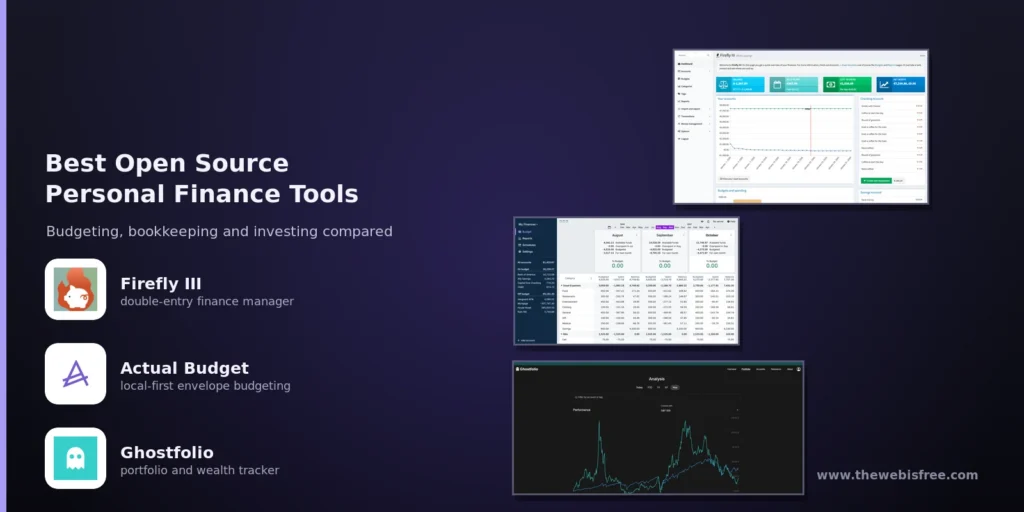
Personal finance is the one area where most of us still keep a spreadsheet we are slightly ashamed of. Open source offers three genuinely different answers: Firefly III is a double-entry ledger for people who want their accounts to reconcile, Actual Budget is an envelope budget, and Ghostfolio is a portfolio tracker for money that is invested rather than spent.
Comparing them is useful because “which is the best free budgeting app?” hides a second question — what are you actually trying to track? All three are free, open source and self-hostable.
1. Firefly III — The Full Double-Entry Ledger
Firefly III is the closest thing open source has to a proper accounting system you can run at home. Money always moves between two accounts, so the books reconcile the way an accountant expects them to. It is AGPL-3.0 licensed, written in PHP, and the current release is 6.7.9 (11 October 2026).
- Double-entry accounting in multiple currencies — withdrawals, deposits and transfers are modelled properly, so an asset account total actually means something.
- Rule engine — the standout feature. Rules rewrite a transaction as it arrives: rename a payee, attach a category, split an amount. It exists partly so your bank’s CSV export can be beaten into shape once, then handled automatically.
- Budgets, categories and tags — all three at once, with limits in multiple currencies, so you are not forced into one mental model.
- Reports and a JSON API — spending per week, month or year, plus an API good enough that third-party mobile clients keep appearing.
Install self-managed (PHP and a database) or run the Docker image; a companion Data Importer handles bulk imports.
2. Actual Budget — Envelope Budgeting That Works Offline
Actual Budget is a different philosophy: envelope budgeting, where every pound is given a job before it is spent. It is MIT licensed, very actively developed, and the current release is 26.10.0 (2 October 2026).
- Local-first — your budget is a file on your own machine. It works with no server, no account and no connection; syncing is something you opt into.
- Envelope budgeting — months side by side, categories with rollover balances, and a “To Budget” figure that tells you honestly whether a month adds up.
- Optional sync and bank sync — actual-server gives you encrypted sync; bank sync needs your own API credentials from a provider such as GoCardless or SimpleFIN, and the project warns those tokens sit outside the encryption protecting your budget data.
- Schedules, rules and reports — recurring transactions, automatic payee handling and split transactions, in a genuinely pleasant interface.
3. Ghostfolio — The Investment Portfolio Tracker
Ghostfolio is the odd one out, and it is worth being blunt about why: it is not a budgeting app. It is wealth management software for money you have already invested — stocks, ETFs and cryptocurrencies — so it answers “how is my portfolio doing?” rather than “can I afford this?”. It is AGPL-3.0 licensed, at release 3.91.0 (23 October 2026).
- Portfolio performance — Return on Average Investment including dividends, over Today, WTD, MTD, YTD, 1Y, 5Y or Max.
- Benchmark comparison — chart your portfolio against a market index, the quickest way to learn whether you are beating the market or just feeling lucky.
- Allocation analysis and risk checks — how the money splits by asset class, region or currency, plus the project’s static analysis of potential risks.
- Multi-account, imports and a PWA — holdings across several brokers in one mobile-first, installable app.
Self-hosting means Docker and Postgres. A paid cloud version exists too, and the project is refreshingly honest that its revenue funds development and the market data behind it.
Head-to-Head Comparison
Data ownership and privacy
All three run on your own hardware. Actual Budget goes furthest — a local file with optional encrypted sync — while Firefly III keeps everything in your database and Ghostfolio holds your data in a server you maintain.
Bank sync
Actual Budget is the only one with real provider integrations built in, and even there you bring your own keys. Firefly III is import-driven: CSV files and the Data Importer do the work, with rules cleaning up the mess. Ghostfolio takes imports or manual entries.
Investment tracking
Ghostfolio wins outright, with dividend-inclusive returns, benchmark comparison and allocation breakdowns. Firefly III tracks balances but has no benchmark analysis, and Actual Budget’s reports are about spending rather than returns.
Mobile and day-to-day UX
Actual Budget is the friendliest and fine on a phone; Ghostfolio is mobile-first as an installable web app; Firefly III is desktop-first — information-dense, but designed for a big screen.
Hosting effort
Actual Budget is lightest, needing no server unless you want sync. Firefly III needs PHP and a database, or one container. Ghostfolio needs Docker plus Postgres, and wants to be online for market data.
Which One Should You Pick?
Choose Firefly III if you want the books to balance. With several accounts, more than one currency, or statements you have never reconciled, its double-entry model and rule engine repay the setup time.
Choose Actual Budget if you want to change how you spend. Envelope budgeting is the most effective habit change in personal finance, and Actual makes it pleasant — it is the one I would hand to someone who has never run a server.
Choose Ghostfolio if your money is mostly invested. It will not tell you where your salary went, but it will tell you whether your portfolio is any good.
Not ready for a web app? GnuCash is still the desktop benchmark, and if the books belong to a business, Akaunting and Invoice Ninja are the better fit.
The Bottom Line
These three are not really rivals: Firefly III is an accounting system, Actual Budget is a budgeting habit, and Ghostfolio is an investment dashboard. For a typical household I would pick Actual Budget, because it changes behaviour rather than simply recording it. Firefly III wins on rigour, and Ghostfolio on the question it was built to answer.
Try them at firefly-iii.org, actualbudget.org and ghostfol.io — free, no subscriptions, no account required.
Looking for more? Browse the Finance and Accounting directory or the full list of tools, and if something you rely on is missing, submit a tool.