MinusPod
- Platform
- Docker Self-hosted Web
- Licence
- MIT Open source
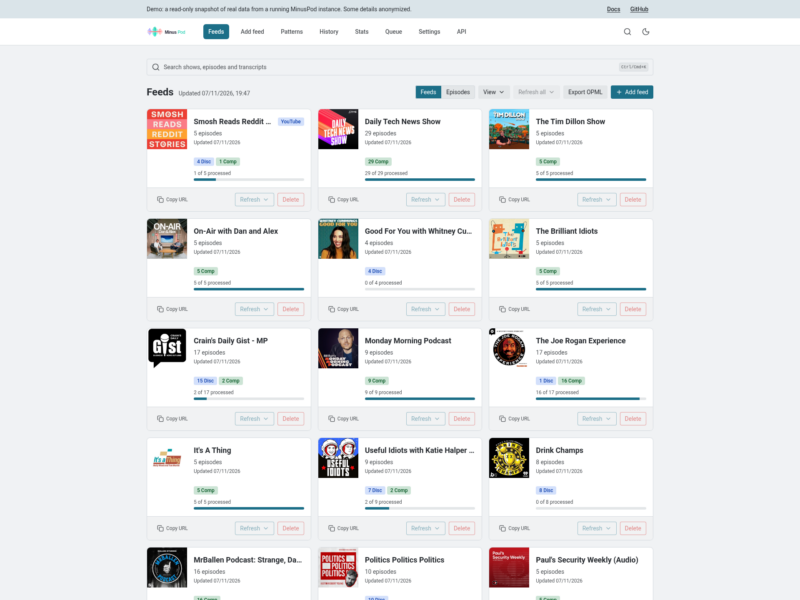
MinusPod
Website: minuspod.app
MinusPod is a self-hosted server that strips adverts from podcasts and YouTube shows before you hit play. Point it at an RSS feed, a playlist or a channel and subscribe to the replacement feed it serves; it works with any podcast app that accepts a custom RSS URL. The software is free and open source under the MIT licence, but it is not a hosted service: you run it yourself in Docker and supply an LLM. A local Ollama model, or the no-LLM mode, avoids API bills; Claude, OpenRouter and other hosted providers add their own usage costs.
The pipeline is transcript-first. Episodes are transcribed with faster-whisper or NVIDIA Parakeet locally, or through a remote API, and a language model marks the advert segments. FFmpeg cuts them, a second pass re-checks the processed audio, and an optional reviewer stage confirms or adjusts each boundary. The part we find most useful is what happens after a correction: edits made in the waveform editor become patterns, and those patterns catch repeat sponsors without another LLM call. Re-cut feeds carry regenerated Podcasting 2.0 transcripts and chapters, with value-for-value tags passed through.
Key Features
- Transcript-first detection: Local or remote Whisper keeps timestamps, an LLM marks the advert segments, and a second pass verifies the cut on the processed audio.
- Optional ad reviewer: A third LLM stage confirms, trims or rejects each boundary, and can bring back borderline detections.
- Pattern learning: Corrections become cross-episode patterns scoped to a podcast, a network or the whole install, with a sponsor list and aliases.
- Five processing modes: Standard detection, keep content only, skip ad detection, cue-only and pass-through are set per feed.
- Review queue and waveform editor: Low-confidence cuts wait for a human; each category (sponsor, cross-promo, self-promo, intro/outro) resolves to remove, beep, keep or a skippable chapter.
- Bring your own model: Anthropic, OpenRouter, Ollama, System One or any OpenAI-compatible endpoint, switchable at runtime; with no LLM configured it falls back to audio cues, fingerprints, learned patterns and SponsorBlock.
- Podcast app publishing: Versioned audio with loudness levelling, regenerated transcripts and chapters, Podping refresh, OPML import/export and podcast search.
- YouTube feeds: A playlist or channel becomes a podcast feed through yt-dlp, with SponsorBlock marks applied as given; the feature is off by default.
Licence
MIT. You can run, modify and redistribute it, including commercially, provided the copyright notice is kept. The licence does not include a model: the recurring cost is whatever LLM, transcription API or hardware you choose.