Pterodactyl vs Pelican vs PufferPanel — Best Self-Hosted Game Server Panel Compared
Ask a self-hosting forum how to run a Minecraft, Palworld or Valheim server for friends and you will get one answer: Pterodactyl. It earned that reputation. A clean web panel, a daemon that puts every game server in its own Docker container, and a huge library of community-made “eggs” that describe how to install and run almost any game. But it is no longer the only serious choice. Pelican Panel is a fork from people who worked on Pterodactyl and wanted a faster-moving successor, and PufferPanel goes the other way: fewer moving parts, less hardware, less to learn. Here is how the three differ when you are the person doing the install.
All three are free software with a web interface for creating servers, watching consoles and managing files. What separates them is what sits underneath.
1. Pterodactyl — The Incumbent
Pterodactyl is a PHP and React panel paired with Wings, a Go daemon that runs on each node and starts every game server inside an isolated Docker container. The panel never runs game code itself; it talks to Wings, and Wings does the container work. That split is why a single panel can drive several machines, and why a broken game server cannot take the panel down with it.
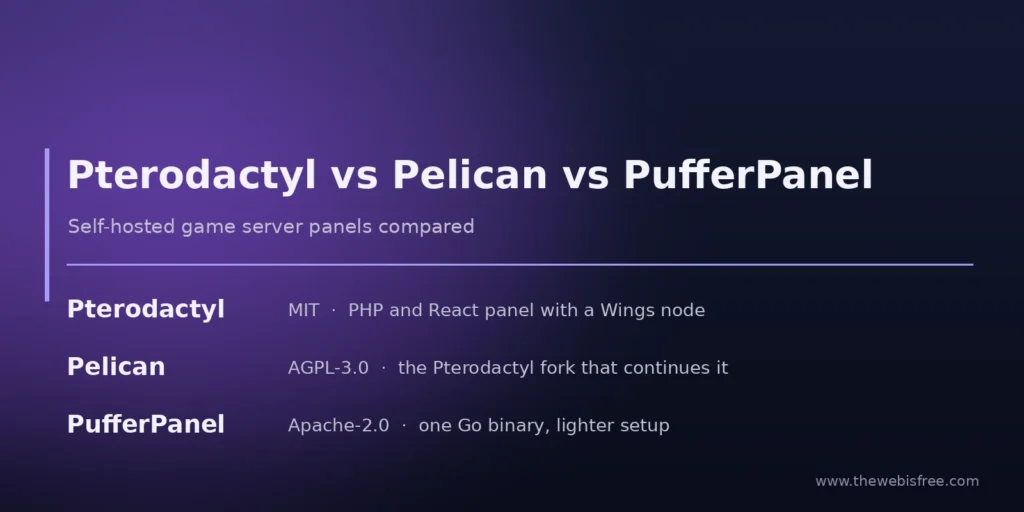
- Licence — MIT, verified in the repository’s LICENSE.md. The upcoming 2.0 line is stated by the project to remain MIT.
- Current releases — 1.15.x is the stable line; a 2.0 beta is in progress with a redesigned admin area and an extension SDK.
- Strengths — the largest egg catalogue, per-user and subuser permissions, a client and application API, SFTP access, and backups to local disk or S3-compatible storage.
- Trade-offs — two components to install and keep in step, and two branches in play at once.
2. Pelican — The Fork That Moved On
Pelican is a fork of the Pterodactyl panel maintained by former contributors to that project. The architecture will feel familiar: a Laravel panel manages one or more nodes, and each server runs in an isolated Docker container through Wings, which Pelican maintains as its own fork. Eggs come from the Pelican eggs organisation, covering Minecraft, SteamCMD titles, bots, databases and voice servers.
- Licence — AGPL-3.0, a real difference from Pterodactyl’s MIT if you plan to modify the panel and host it for others.
- Current releases — the 1.0 line is still going through release candidates.
- Strengths — modern interface, the same isolation model as Pterodactyl, a clean migration story for people already inside that ecosystem.
- Trade-offs — a younger project with a smaller community, and 1.0 is not yet a final release.
3. PufferPanel — The Lightweight Option
PufferPanel aims at personal servers and small networks rather than hosting companies. It ships as a single Go binary that serves the web panel and manages the servers on the node, so there is no separate daemon to pair with it. Servers run in an environment you choose, either directly on the host or inside Docker, and each user gets their own servers and permissions.
- Licence — Apache-2.0.
- Current releases — 3.0.9 shipped in July 2026.
- Strengths — the quickest of the three to get running, modest resource use, an OAuth2-based API, and no requirement to run Docker unless you want isolation.
- Trade-offs — a smaller template library than the egg catalogues, and fewer of the multi-node features a hosting provider expects.
Head-to-Head
- Install complexity — PufferPanel is one binary and a config file; Pterodactyl and Pelican each need a web stack, a database and a Wings node on top.
- Multi-game support — Pterodactyl has the deepest catalogue, Pelican inherits most of it, PufferPanel covers the popular titles with a thinner list.
- Isolation — Pterodactyl and Pelican isolate every server in Docker; PufferPanel leaves that choice to you.
- Resource limits — all three cap memory and CPU per server, but Pterodactyl and Pelican enforce them at the container level.
- Backups — Pterodactyl and Pelican both support scheduled backups to local or S3-compatible storage.
- Permissions — Pterodactyl and Pelican separate users from subusers per server; PufferPanel uses users and permission groups.
- API — Pterodactyl and Pelican expose client and application APIs; PufferPanel offers an OAuth2 API.
- Migration path — going from Pterodactyl to Pelican keeps the same shape, while moving to PufferPanel means recreating servers.
Which One Should You Pick?
- You want the safest default and the widest game support — install Pterodactyl 1.15 and ignore the beta until 2.0 settles. The documentation and community answers are unmatched.
- You already run Pterodactyl or care about where the project is heading — Pelican is the continuation, with the same isolation model and a more active rewrite. Accept that 1.0 is still a release candidate.
- You want one server box for you and a few friends, tonight — PufferPanel gets you to a working console with the least setup and the smallest footprint.
The Bottom Line
Pterodactyl is still the right answer for most people, because the egg catalogue solves the problem you will hit: getting a specific game installed correctly. Pelican is the one to watch, and the one to choose if you want to be on the branch where development is happening. PufferPanel is underrated for the small case, where the Pterodactyl stack is more machinery than a single server needs.
Browse more self-hosted tooling in the full directory, or suggest a tool we have missed.