WeTTY
- Platform
- Linux macOS
- Licence
- MIT Open source
- Website
- butlerx.github.io/wetty
- Source code
- github.com/butlerx/wetty
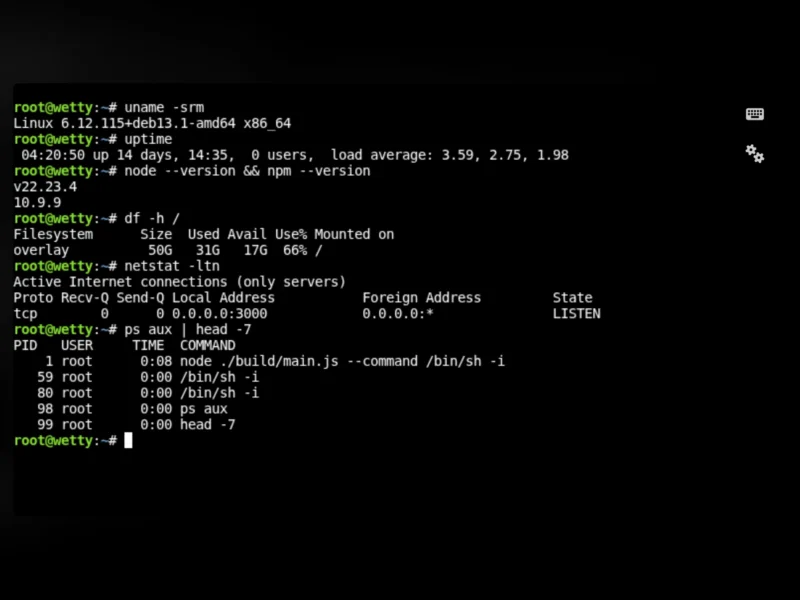
WeTTY (Web + tty) is a terminal in the browser. It runs a small Node.js server that holds a real pseudo-terminal and hands it to xterm.js in the page, so the session you get is a genuine shell or SSH connection rather than an emulation of one. It ships as an npm package and as a Docker image, which makes it easy to bolt onto a self-hosted stack behind the same reverse proxy as everything else.
What it does
- Renders a full xterm.js terminal in the browser, with scrollback, clipboard copy and a session title you can set.
- Spawns a local shell, or connects out to an SSH host with
--ssh-host,--ssh-portand--ssh-user, using password or key authentication. - Speaks HTTP or HTTPS directly (
--ssl-keyand--ssl-cert), and can also sit behind nginx, Caddy or Traefik on a sub-path with--base. - Locks the websocket to the browser origins you list with
--allowed-origin— the server refuses to start until at least one origin is configured. - Ships a web manifest, so the terminal can be installed as a standalone window from the browser.
Running it
The published image is wettyoss/wetty: docker run -p 3000:3000 wettyoss/wetty --ssh-host 10.0.0.5 --ssh-port 22 --ssh-user ops. Started without an SSH target it opens a local shell as the container user. There are no accounts inside WeTTY itself, so the port must be protected by a reverse proxy with authentication, a VPN or both — anyone who reaches the socket gets a terminal.
Licence
MIT. Free to use, modify and redistribute, including in commercial deployments. The licence is in the repository’s LICENSE file.
Alternatives
- ttyd and GoTTY — single-binary web terminals from the Go ecosystem that expose one command rather than a login shell.
- SSH in a browser via a full remote-desktop gateway (Apache Guacamole) when you need more than a text terminal.