Windmill
- Platform
- Docker Self-hosted Web Linux
- Licence
- AGPL-3.0 core, Apache-2.0 clients, proprietary enterprise features Open source
Windmill
Website: http://www.windmill.dev
Windmill is an open-source, self-hostable platform for turning scripts into workflows, internal apps and AI agents. You write a plain function in Python, TypeScript, Go, Bash or SQL, and Windmill reads its typed arguments to generate a form, an HTTP endpoint and a CLI command. You can then chain scripts into a flow, add a UI, or trigger the code from a schedule, webhook or message queue. We would reach for it when a script needs a UI, a schedule and a place for secrets without another service. The current release is v1.876.0.
Unlike a no-code builder, Windmill keeps the source as code: it syncs with Git, can be edited in VS Code or the browser, and reviewed and promoted like any other change. Windmill is written in Rust with a Svelte frontend and uses Postgres for both state and its job queue; workers pull jobs by tag, so development and production workers can sit in different networks. The project positions itself as a self-hostable alternative to Retool and n8n, and benchmarks against Airflow, Prefect and Temporal. It is not wholly permissive open source, though.
Key Features
- Scripts in many languages: Python with uv, TypeScript and JavaScript on Bun, Go, Bash, SQL, GraphQL, PowerShell, Rust, C#, Java and Ansible; npm packages are resolved and pinned automatically.
- Generated interfaces: typed arguments become an input form, an HTTP route and a CLI command, so the same function can run for a person or another service.
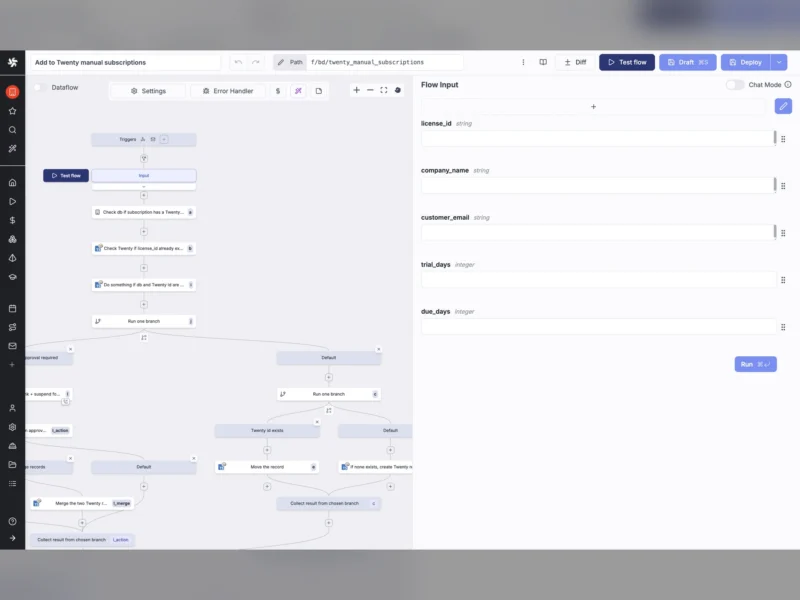
- Flows and workflows as code: compose scripts in the visual flow editor, as YAML, or as code; each task runs as its own job with logs, and an approval step releases the worker while it waits.
- Apps: build full-code React or Svelte front ends, or build a UI on the same scripts and flows.
- Data tooling: managed Postgres data tables, DuckDB over S3 and Azure Blob files, DuckLake lakehouse tables, pipelines (alpha) and unmodified dbt projects.
- Self-hosting: a three-file Docker Compose stack or a Helm chart, with stateless API servers and workers around Postgres; the project quotes about 50 ms queue overhead per job.
- Isolation and secrets: nsjail sandboxing and PID namespace isolation for jobs, a per-workspace encryption key for credentials, secrets permissioned by path, and SSO through Google, Microsoft or Okta.
- Developer tooling: CLI, VS Code extension, two-way Git sync, an MCP server for coding agents, and browser AI sessions with a diff to review before deploying.
Licence
The core backend and frontend are AGPLv3, the API clients and OpenAPI specification are Apache 2.0, and some enterprise features are proprietary. The Community Edition in the project’s images and binaries includes that proprietary code: it is free to use inside an organisation within the software’s limits and quotas, but reselling it, serving it as a managed service, or re-exposing it as part of your own product needs a commercial licence. For a fully open-source build, compile without the enterprise flag and comply with the AGPLv3.