Dozzle
- Platform
- Docker
- Licence
- MIT Open source
- Website
- dozzle.dev
- Source code
- github.com/amir20/dozzle
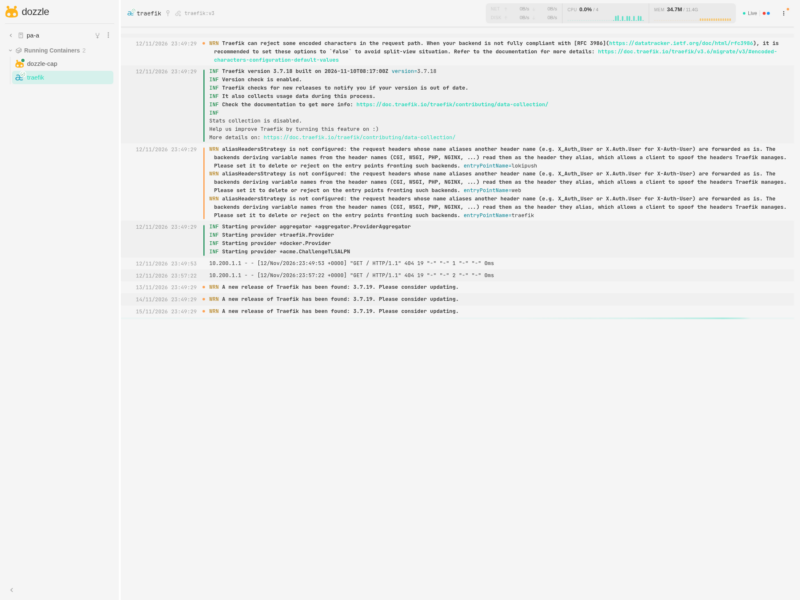
Overview
Dozzle is a lightweight web interface for watching Docker container logs in real time. It is a single small container that mounts the Docker socket and serves a live view of every container’s stdout and stderr in your browser — no Elasticsearch, no database, no log shipping pipeline. Nothing is written to disk: Dozzle is built for reading what is happening right now, not for archiving it.
That focus is the point. The image is around 7 MB compressed, memory use is in the tens of megabytes, and starting it is one docker run with a socket mount. Behind the simple premise sits a competent log tool: regex and SQL-style filtering, fuzzy container search, split-screen streams, live CPU and memory counters per container, and multi-user authentication for teams that cannot leave logs open to anyone who can reach the port.
Key Features
Searching and reading logs
- Fuzzy container search across every container on the host, so you can jump to one by typing a fragment of its name.
- Regular-expression search inside the live stream, for grepping a request id, a status code or a stack frame as it arrives.
- SQL queries over the log stream through the built-in engine, for filtering and aggregating without an external log database.
- Split screen for following two or more containers side by side — the usual way to debug a service and its proxy together.
- Live stats with per-container memory and CPU usage in the same view as the logs, plus host-level disk and resource figures.
- Dark mode for late-night log reading.
Multiple hosts and environments
- Agent mode for monitoring several Docker hosts from one Dozzle instance: each remote host runs a small agent, and the central UI lists them all.
- Swarm mode support for services spread across a Swarm cluster.
- Works with Podman and Colima as well as Docker, using Podman’s Docker-compatible socket.
Access control
- Multi-user authentication with users stored in the container’s
/datavolume. - Forward proxy authorization, so an existing reverse-proxy auth layer such as Authelia can decide who sees the logs.
How It Works
Dozzle talks to the Docker API directly over the mounted socket and streams container output to the browser over its own connection, so logs are never buffered to disk. API version negotiation is automatic, which is why it copes with a range of engines; the hard floor is Docker Engine 19.03 (API 1.40) or newer. On Podman, the remote socket has to be enabled first, because Podman is daemonless and has no engine identity to report — Dozzle derives a stable host id itself.
Configuration follows the twelve-factor convention: CLI flags or environment variables, documented in full on the project’s site. Dozzle collects anonymous usage configuration through Google Analytics, which the project explains as the only feasible way for an unfunded open-source tool to know how it is used; the collected data is public in a live dashboard.
Deployment and Requirements
The container is published as amir20/dozzle and the documented run is a single command that mounts the Docker socket and a named volume for /data, exposed on port 8080; a compose file with the same mounts is provided for anything longer-lived. The /data volume matters: user accounts and settings live there, so without it the login configuration is lost the next time the container is recreated. For remote hosts, the same image runs in agent mode on its own port. There is no package in any distribution repository — Docker or Podman is the delivery mechanism.
Use Cases
- Debugging a compose stack without
docker logs -fin a terminal per service. - Watching application and reverse-proxy logs side by side while reproducing a request.
- Giving a small team read access to container logs without handing out shell access to the host.
- Spotting which container is eating memory from the per-container stats next to its output.
- Aggregating logs from a handful of Docker hosts through agents, without standing up a log store.
Alternatives
- Logdy — a web log viewer that can also tail files and pipe output into a browser UI.
- Loggifly — a lightweight web log viewer for Docker containers.
- Grafana Loki — log aggregation that stores and indexes logs for later search; Dozzle deliberately stores nothing.
- Graylog — a full log management platform with retention, alerting and long-term search.