Ergo
- Platform
- Linux macOS Windows Docker
- Licence
- MIT Open source
- Website
- ergo.chat/
- Source code
- github.com/ergochat/ergo
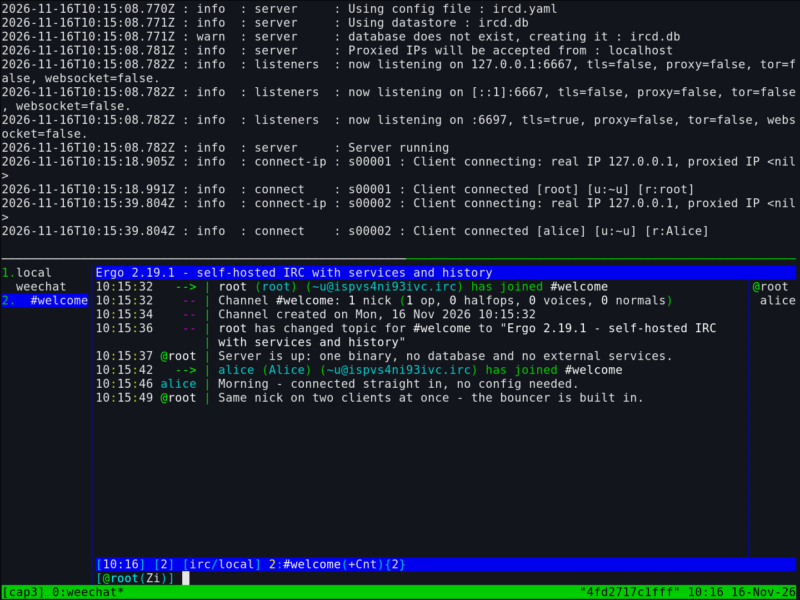
Ergo is an IRC server — a chat daemon in the classic IRC sense — written in Go and built to be the whole backend in one binary. It folds together three things that used to need three separate installations: the ircd that carries the channels, the services that own user accounts and channel registration, and a bouncer that stores history and lets several devices share one nickname. One YAML file configures everything, and it can be rehashed while the server runs, so a certificate renewal or a policy change does not mean dropping everyone off the network.
What you get
- Services included — NickServ, ChanServ and HostServ ship inside the daemon: account registration, channel ownership, vanity hosts and account-based bans work without a separate Anope or Atheme deployment.
- Bouncer behaviour built in — messages are stored and replayed, and one nickname can hold several simultaneous clients, so a phone and a laptop stay in sync without a ZNC in front.
- IRCv3 reference implementation — the project tracks IRCv3 closely and is used as a reference implementation, including SASL authentication and the modern message-tag extensions.
- Security and privacy controls — native TLS including client certificates, IP cloaking, a require-SASL mode for the whole network, Tor hidden-service operation, bcrypt-stored passwords and automated connection limits.
- Operator tooling — an extensible privilege system,
UBANfor banning IPs, networks, masks and accounts in one command, plus KLINE and DLINE, and ident lookups for usernames. - Rehashable configuration —
ircd.yamlholds the entire setup and reloads at runtime, including TLS certificates. - Small footprint — a single static Go binary with an embedded key/value store; no MySQL, Redis or external database to run alongside it.
- Optional extras — LDAP authentication via
ergo-ldap, translated responses for a multilingual network, and UTF-8 nicknames and channel names per RFC 8265.
Deployment
Grab the release tarball for your platform, rename the shipped example config and generate certificates:
cp default.yaml ircd.yaml
./ergo mkcerts
./ergo run
The image ghcr.io/ergochat/ergo is published to the GitHub Container Registry and the repository carries an example docker-compose recipe. Distribution packages exist for Debian and Ubuntu, Arch (AUR) and Gentoo, and binaries cover Linux, macOS and Windows. The operator manual includes a productionizing guide for systemd, reverse-proxy and Tor setups.
Where it fits
Ergo is the server side of IRC: install it when you want to run your own network rather than join someone else’s. It pairs with any IRC client — The Lounge gives a self-hosted web front end and Convos is the browser client alternative — and it is a lighter path to a private chat network than a full groupware stack when all you want is channels, accounts and history.
Licence
MIT — open source, verified against the repository’s LICENSE file.