BroadcastChannel
- Platform
- Web Docker
- Licence
- AGPL-3.0 Open source
- Website
- memo.miantiao.me
- Source code
- github.com/miantiao-me/BroadcastChannel
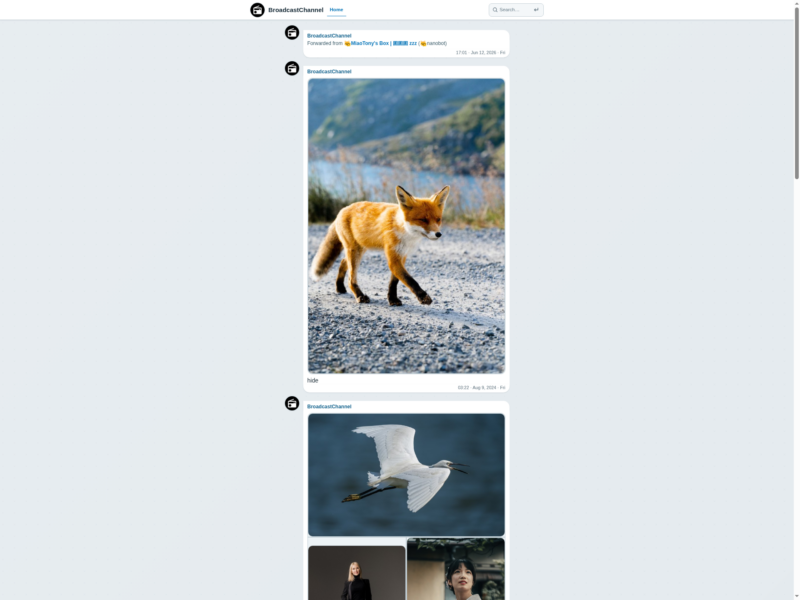
BroadcastChannel turns a public Telegram channel into a small, fast website. Instead of bolting a blog onto a chat tool, it takes the channel as the only content source and renders the posts — text, photos, albums, videos, forwarded messages — as a microblog feed with a search box, tags and RSS. There is no admin panel to log into and no database to run: if you can post to the channel, you have published.
What it renders
- Channel feed — posts appear newest-first as cards, with the author avatar, timestamp, photo albums, video and forwarded-message attribution preserved from Telegram.
- Per-post pages and tags — each message gets its own URL for sharing and search-engine indexing, and a tag list can be configured to build topic pages.
- Search — a built-in search box scoped to the site (an optional Google site-search target can be set instead).
- Feeds and SEO —
/rss.xmland/rss.json, a/sitemap.xml, per-post Open Graph metadata, andNOINDEX/NOFOLLOWswitches for staging builds. - No client-side JavaScript by default — the pages are server-rendered HTML plus CSS, which is why they load quickly on a phone over a slow connection.
- Comments and reactions — both are on by default and can be turned off with the
COMMENTSandREACTIONSenvironment variables.
How it works
The app is built with Astro and reads the channel’s public preview, so the only required setting is CHANNEL — the channel username, the string after t.me/. No bot, no API key and no write access to Telegram are involved; the site is a read-only front end and everything is published from the Telegram app itself. That has two consequences worth knowing before deploying: the channel must be public, and “Restricting Saving Content” has to be switched off in the channel settings, otherwise the feed renders empty. The project’s FAQ suggests opening https://t.me/s/ plus the channel username as the quickest way to check that Telegram is serving the channel publicly.
Deployment
The published container is a single image with one environment variable:
docker run -d --name broadcastchannel -p 4321:4321
  -e CHANNEL=your_channel ghcr.io/miantiao-me/broadcastchannel:main
The same build also runs on serverless platforms that support SSR — Cloudflare Workers, Netlify, Vercel and EdgeOne — with CHANNEL set as a project variable or (on Workers) with pnpm exec wrangler secret put CHANNEL. Cloudflare Pages SSR is not supported with the current Astro 6 + @astrojs/cloudflare v13 stack, so use Workers for Cloudflare deployments. Everything else is optional configuration: LOCALE and TIMEZONE for formatting, social usernames and links for the footer, plus HEADER_INJECT/FOOTER_INJECT for trusted-admin HTML.
Themes
A base stylesheet always loads, and exactly one optional theme can be layered on top of it through HEADER_INJECT: Sepia, Aria, four Terminal variants (amber, green, cyan, magenta), HN News, TG Channel, ZAE and Polar. The last four are fixed-light designs; the Terminal set is a monochrome dark theme. Custom CSS is supported on top of any of them.
Good to know
BroadcastChannel is a publishing front end, not a chat client — it cannot read private channels, send messages or moderate comments, and it has no concept of multiple authors beyond Telegram’s own forwarding attribution. It also inherits Telegram’s rendering of the message: the site cannot reformat a post that was published badly in the channel. For anyone already running a Telegram channel as a news feed, that is the point — the channel stays the single place to write, and the site is a cheap, indexable shop window for it.
Alternatives
- WriteFreely — self-hosted minimalist blogging, if you would rather write on the web than in Telegram.
- Ghost — a fuller publishing platform with newsletters and memberships.
- Rocket.Chat — team chat you host yourself, when the conversation matters more than the archive.