Dittofeed
- Platform
- Docker
- Licence
- MIT Open source
- Website
- dittofeed.com/
- Source code
- github.com/dittofeed/dittofeed
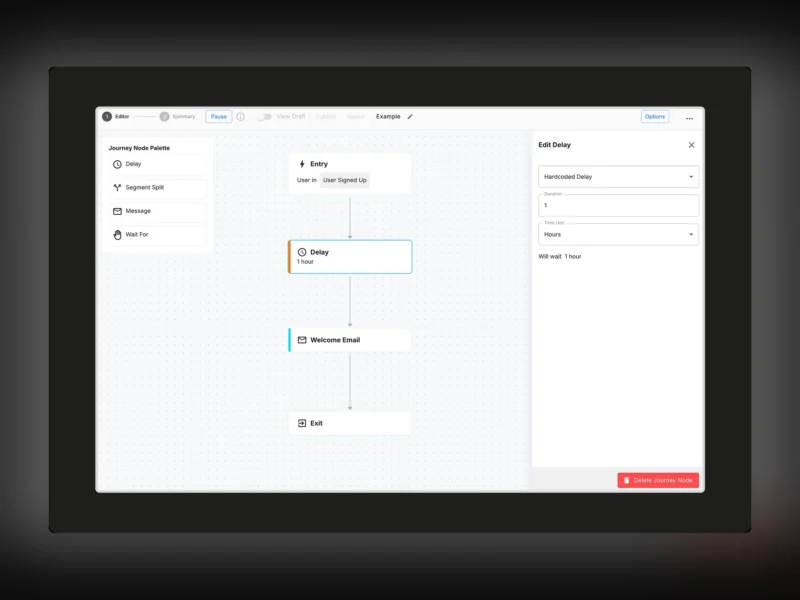
Dittofeed is a self-hosted customer engagement platform for sending broadcasts and running automated, event-triggered user journeys across email, mobile push, SMS, WhatsApp and Slack. It positions itself as the open-source, developer-friendly alternative to OneSignal, Customer.io and Segment Engage: user data arrives from Segment, a reverse-ETL job or the Dittofeed API, segments are built from traits, events and computed properties, and messages leave through an email service provider you plug in yourself.
The product is a TypeScript application with a React dashboard, split into API, dashboard and worker services, with a ClickHouse store behind the analytics. The shipped docker-compose file brings up the app alongside Postgres and ClickHouse, with Kafka as an optional dependency for the event pipeline.
Features
- Journeys: a node-based builder for event-triggered flows with delay, wait-for-event, boolean branch, segment split, message and webhook nodes, and per-user journey state
- Broadcasts: one-off sends to a segment, scheduled to a chosen message channel
- Segments: trait, event and computed-property conditions combined with multiple operators, plus user grouping for team or company membership
- Templates: HTML/MJML or a low-code editor with a command palette for email editing
- Message channels in one abstraction: email, mobile push, SMS, WhatsApp, Slack and others
- Send through your own ESP, with SendGrid and Amazon SES documented for email
- Message performance tracking in the dashboard
- Git-based workflows: templates in your own editor and checked into git, branch-style version control for campaigns, and a testing SDK to exercise journeys in CI
- Embedded components: mount the journey, segment or template builder inside your own application via iframe or a headless React component
- Self-hosted deployment inside your own VPC, plus documented Render, Kubernetes and CloudFormation recipes
What to know before you deploy
- MIT licensed and free to run. Multi-tenancy, white-labelling and embedding are sold as a separately licensed closed-source edition; the community build is otherwise the full self-hosted product.
- It is not a mail server. You bring SendGrid, SES or another ESP for delivery, so domain verification and sender reputation stay your job.
- It is heavier than a single container: Postgres and ClickHouse are required and Kafka is optional, so budget for several services before the application itself.
- Authentication is configurable (single-tenant password login or an external identity provider), so read the auth docs before exposing an instance publicly.
Alternatives
Listmonk is the minimal newsletter sender with no journeys; Keila adds a block editor and basic automation; Mautic is the heavyweight marketing-automation suite. Dittofeed is the closest fit when you want event-driven journeys with a developer workflow behind them.