Specifically Clementines
- Platform
- Web Android iOS Docker
- Licence
- MIT Open source
- Source code
- github.com/davideshay/groceries
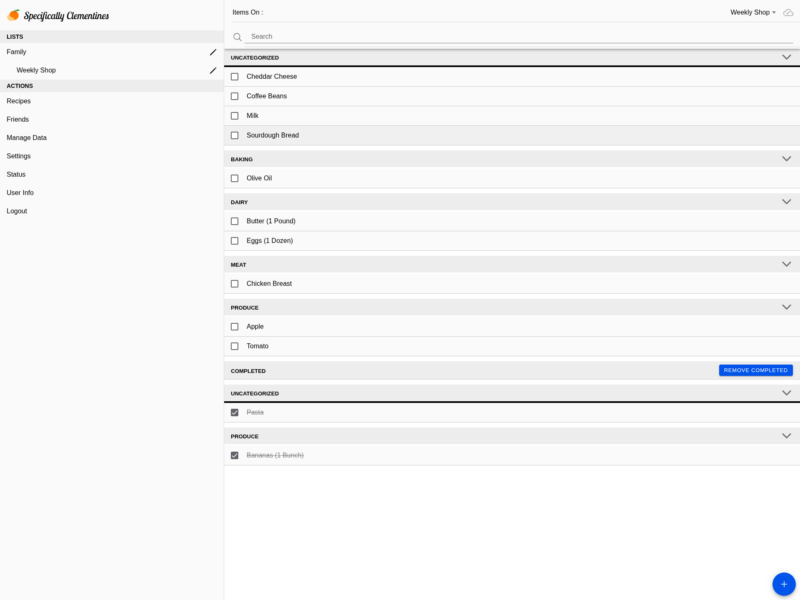
Specifically Clementines is a self-hosted shopping list built for households where more than one person writes on the list. It began life as “Groceries” and was renamed after the developer’s daughter made it clear that only clementines would do. The brief was deliberately narrower than most grocery apps: keep several lists in sync across phones and browsers in real time, and never silently lose an update.
How it works
Everything is organised around lists and list groups. A list group is what you share with the rest of the household or with a particular round of shops, and an item can sit on several lists at once: buy it once and it is ticked off everywhere it appeared. The shopping view groups items by store category, so the list reads in aisle order instead of in the order people added things.
- Multiple shopping lists, grouped into list groups with per-group sharing
- An item can be on many lists and is checked off on all of them in one action
- Queue an item across several stores: if the first shop does not stock it, it stays on the list for the next
- Categories map to aisles so each list can be walked in a single pass
- Recipes add their whole ingredient set to a list at once, with Tandoor imports
- Real-time sync with the sync state always visible, automatic conflict resolution and a view of what was resolved
Offline use
The client keeps working with no connection and pushes the changes when the network comes back, which matters in the parts of a supermarket where the signal drops. Each device keeps its own copy and the server reconciles them, so a shop that started offline still ends up on everyone else’s phone.
Running it yourself
The stack is a Node/Express API, a React client shipped as a web app plus Android and iOS builds, and CouchDB for storage. The project publishes Docker images for both the server and the client alongside a ready-made compose file and the CouchDB configuration it expects; put your own reverse proxy in front for TLS. The setting people trip over is COUCHDB_URL: it has to be reachable from the phone itself, not just from the host running the stack. Account creation is open on a fresh install and can be closed with DISABLE_ACCOUNT_CREATION.
Good to know
It is a shopping list, not a pantry manager: there is no stock counting, expiry tracking or consumption history here. If that is what you need, Grocy is the closer fit, and the two serve different jobs rather than competing. An optional Alexa skill lets you add items by voice, and the documentation covers the full user guide, the compose files and the mobile build steps.