Spliit
- Platform
- Web Docker iOS
- Licence
- MIT Open source
- Website
- spliit.app
- Source code
- github.com/spliit-app/spliit
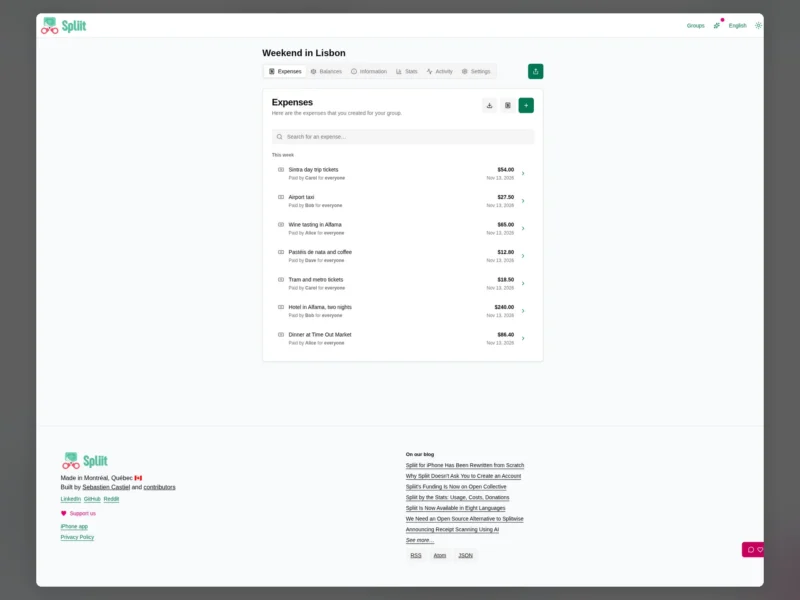
Spliit is a minimalist expense-sharing application for groups of friends, families and flatmates — the open source answer to Splitwise. The group is the unit: you create one for a trip, a shared flat or a gift, add the people by name, and everyone can open the same page from a link. There is no account system at all: no email, no password, no sign-up for the people you are splitting with, which is the deliberate design choice behind the project.
How a group works
A group carries a name, a main currency and a list of participants typed in as plain names. The first screen is the expense list for that group, grouped by period, with the description, who paid, the amount and the date; a second tab holds the balances, a third the group information and settings, and there is an activity log and a statistics view alongside them. Opening a group on a new device asks which participant you are and remembers the answer locally, so the same group link can be used by everybody without a login step. Groups can be marked as favourites from the groups index.
Recording an expense
An expense is a description, an amount, who paid, and who it was paid for. All participants are selected by default and can be deselected one by one; an expense can be split evenly, or unevenly by percentage, by shares or by explicit amounts per participant. Each expense can carry a category from a built-in list, a free-text note, and a receipt image, and the group list can be searched by description. Reimbursement entries are first-class expenses, so paying somebody back appears in the same timeline as the original charge. Receipt images and AI receipt scanning are opt-in features on a self-hosted instance: documents need an S3 bucket, and extracting an expense from a scanned receipt needs an OpenAI API key.
Balances and paying each other back
The balances view totals what each participant paid against what they consumed, so the net position of every person in the group is visible at a glance. The reimbursement view then proposes the smallest set of transfers that settles the group, which is the practical difference between knowing the numbers and actually closing them out. Since no money moves through Spliit, the transfers happen outside the app and are simply recorded as reimbursement expenses.
Running your own instance
The application is a Next.js app written in TypeScript, styled with Tailwind and shadcn/ui, with Prisma over a PostgreSQL database. The project publishes a container image, so the smallest deployment is a two-service compose file: ghcr.io/spliit-app/spliit:latest on port 3000 next to postgres:17.3, with the two POSTGRES_* connection strings passed in and the Next.js cache mounted for persistence. A hosted deployment is also offered by a Deploy to Vercel button that provisions the database at the same time. Runtime configuration needs no rebuild: BASE_URL sets the public address used for metadata, sitemap, robots.txt and server actions, DEFAULT_CURRENCY_CODE picks the currency preselected on the new-group form, and the optional features are switched on with environment flags. Health endpoints at /api/health/readiness and /api/health/liveness cover database connectivity separately from process liveness.
Mobile, languages and limits
The web app is a progressive web app and installs to a phone’s home screen; there is also a native iPhone client. The interface is translated into 24 languages through a hosted Weblate project, and a light and dark theme are both available. Recurring daily, weekly and monthly expenses are in beta, and importing an existing Splitwise history is still on the roadmap rather than shipped, so migrating from Splitwise is a manual re-entry job for now.
Alternatives
- Splitwise — the proprietary service Spliit is designed to replace; free tier limited to a small number of daily expenses.
- Tricount — proprietary group expense splitter with a free tier.
- Firefly III — open source personal finance manager, for tracking your own budget rather than splitting shared bills.
- Actual Budget — open source envelope budgeting with local-first sync.
- GnuCash — open source double-entry accounting for desktop use.