InvoiceShelf
- Platform
- Docker Web Self-hosted
- Licence
- AGPL-3.0 Open source
- Website
- invoiceshelf.com
- Source code
- github.com/InvoiceShelf/InvoiceShelf
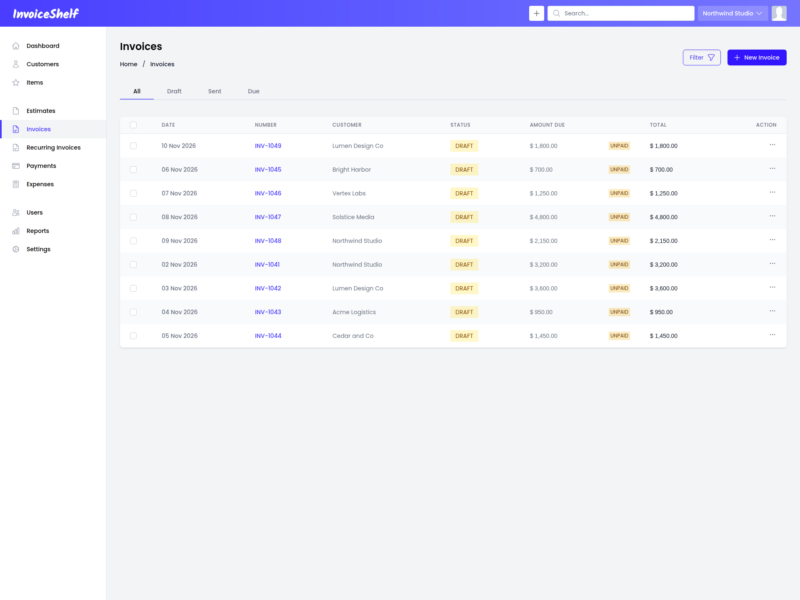
What InvoiceShelf is
InvoiceShelf is a self-hosted invoicing application for freelancers and small businesses, written in PHP with a Vue front end. It covers the working part of billing rather than only the document: customers, invoices, estimates, recurring billing, payments and expenses all live in one install on your own server, so the customer list and the money trail stay under your control instead of in a subscription service.
The project is licensed under the GNU Affero General Public License v3.0 and is distributed both as a Docker image and as a ZIP you can drop on any PHP host and finish through a browser installer. A single container with SQLite is enough to try it; the same application runs against MySQL or PostgreSQL when it has to hold real books.
Invoices, estimates and recurring billing
An invoice is built from line items with quantities, per-item taxes and discounts, and rendered into a PDF from a configurable template with your logo, custom fields and notes. Estimates are a separate document type with their own numbering, so a quote can be issued, tracked and later converted without pretending to be an invoice. Recurring invoices are scheduled once — retainers, subscriptions, maintenance contracts — and the application generates the next document on its own.
Numbering prefixes, due-date windows and default currency are company settings rather than hard-coded values, which matters if you invoice in more than one currency or run more than one business.
Payments, expenses and the dashboard
Payments can be recorded by hand or taken through Stripe, and partial payments, credit notes and payment history are kept against the invoice they belong to. Expenses are a first-class record with their own categories, so the profit figure on the dashboard is sales minus expenses rather than an estimate. The dashboard tallies outstanding and overdue totals, the month’s takings and the recent invoices that still need chasing; overdue invoices can be reminded by email from the same screen.
Customer portal and multiple companies
Customers get a private portal where they can view and download their invoices and pay online, without you issuing them an account on anything else. Several businesses can be run from one installation, each with its own branding, currency and tax settings — useful for contractors who invoice through more than one entity but do not want two servers.
Requirements and installation
The supported install is a PHP web server with a database: the official Docker image bundles nginx and PHP-FPM and can run on SQLite, MySQL/MariaDB or PostgreSQL, and there is a manual path for shared hosting. The installer walks through the database connection, the administrator account and the company details; the application then runs as a normal web app behind your reverse proxy. A scheduled task (cron or the container’s own scheduler) is what actually creates recurring invoices and flags invoices as overdue, so it has to be running.
What to know before you commit
The stable v2 line is in maintenance: security patches only, through September 2027, while new feature work moves to the next major version. That makes v2 a safe place to run today’s books, but a project that wants new capabilities will eventually have to migrate. E-invoicing under EN 16931 — the ZUGFeRD / Factur-X format German B2B accounting expects — arrives with the 3.0 line through an official module rather than in 2.x.
Alternatives
If you want a desktop application instead of a server, Invoice Builder keeps its data in a local file and runs without a web host. InvoiceShelf is the better fit when clients, not just you, need to see and pay their invoices.