Personal Management System
- Platform
- Web Docker
- Licence
- MIT Open source
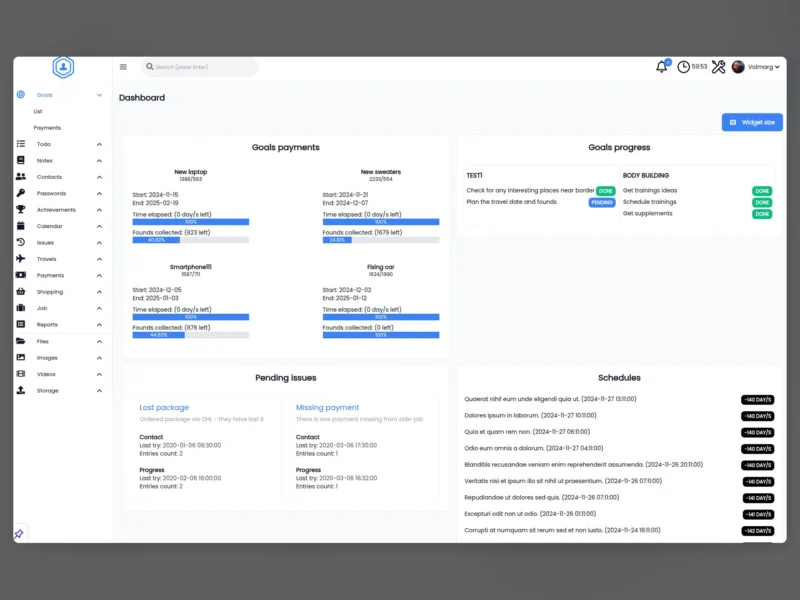
What Personal Management System is
Personal Management System (PMS) is a self-hosted web application for the everyday administrative clutter: contacts, notes, payments, schedules, passwords, files and photos, all in one place you control. The author describes it as closer to a CMS or a CRM in shape than to a to-do app — a set of modules with a shared dashboard — and built for exactly one use case: keeping personal data on a machine in your own network instead of spreading it across OneDrive, Google and a drawer of sticky notes.
That is also its limit and its charm. It is not a team product and does not pretend to be one: there are no boards, sprints or assignees. What it does is collect the small things a household actually tracks, in a single database you can back up yourself.
Modules
The application is organised as modules that share a dashboard:
- Todo and goals — progress tracking for personal goals, including the money you still need to set aside.
- Notes — short entries filed under categories, for the phone-call details and links you would otherwise lose.
- Contacts — a personal address book with its own backup, independent of your phone.
- Passwords — credentials stored encrypted in the database, with a copy button that returns the original.
- Payments — monthly spending with summaries, plus submodules for product prices, owed money and bills.
- Schedules — recurring obligations such as services, renewals and visits, surfaced on the dashboard and in the notification bell.
- Health — illnesses, doctors and appointments, with attached files.
- Travels, shopping, achievements and issues — the wishlist-and-case-file modules: places with a map link and a photo, things to buy, things done, and ongoing cases that need occasional attention.
- Files, images and video — uploads kept in DataTable and masonry gallery views, so the folder is browsable from the browser.
- Job — after-hours tracking against goals and a holiday allowance counter.
- Reports — read-only summaries generated from the data already stored.
How it runs
PMS is a PHP 8.3 application: a Symfony 5.4 backend with a Vue 3 frontend in its own repository, on MySQL. It is deployed with Docker or a classic PHP web server, and the documentation covers installation, the tech stack and the module-by-module usage. There is a public demo with the login admin@admin.admin and password admin, which is the fastest way to judge whether the interface suits you before installing anything.
The intended deployment is modest: something small and always-on at home, ideally without exposure to the internet. That is the same profile as a Raspberry Pi or a spare mini PC on the local network.
Maturity and support
The project has been developed since 2019 and is actively maintained, with releases and fixes landing regularly rather than in bursts — v2.1.0 shipped in September 2026. It is a one-person project, and the author is upfront that support is best-effort: he uses the application daily, so bugs that affect him get fixed, and the code is shared as MIT for anyone who wants to extend it. That is a realistic trade for a tool this personal — the extension points are simple enough that a developer can add a module rather than wait for one.
Licence
Open source — MIT. Both the backend and the frontend repository are MIT-licensed, so you can run it, modify it and keep your fork private.
Open source alternatives
- Vikunja — task and project management with lists, kanban and calendars, better when the work is goal-shaped rather than archive-shaped.
- Super Productivity — time tracking and task planning for the day itself.
- Baïkal — a CalDAV/CardDAV server if contacts and calendars are all you need to self-host.
- Kanboard — a plain kanban board for projects with a clear end.