Kanba
- Platform
- Web Docker
- Licence
- MIT Open source
- Website
- kanba.co
- Source code
- github.com/Kanba-co/kanba
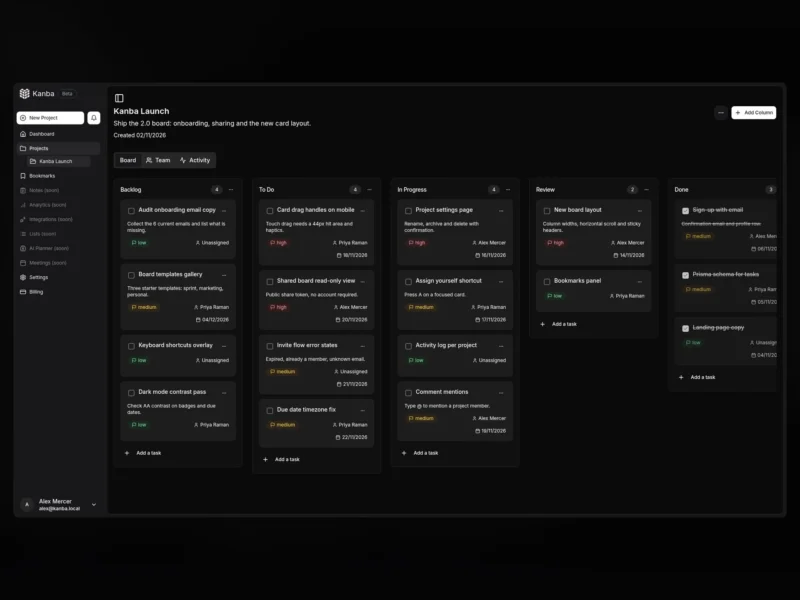
What Kanba is
Kanba is a self-hosted kanban board built for solo developers and small teams who want a Trello-style board without a subscription. The project describes itself as an open-source, lightweight Trello alternative for makers and indie hackers, and puts simplicity, speed and scalability ahead of a deep enterprise feature set.
It is a Next.js application in TypeScript: Tailwind CSS and shadcn/ui for the interface, Supabase for the database and authentication, and Stripe for the paid-plan plumbing on a hosted deployment. The code lives on GitHub under the Kanba-co organisation, and the repository was opened in June 2025.
What a board looks like
- Projects as boards. Each project is a board with its own name, slug and settings, and an installation can hold as many projects as you want to create.
- Lists and cards. Work is organised the familiar way: a board is a row of lists, and cards move along them as the work moves. Cards carry a done flag, so a list can show what has actually finished rather than only what was dragged to the end.
- Shared boards by link. A project can be given a public share token, which exposes that board at a read-only share address without handing out an account. Useful for showing a roadmap to someone outside the team.
- Bookmarks beside the boards. The dashboard also collects bookmarks, so links you keep coming back to during a project do not have to live in a card.
- Team accounts. Users sign in with their own profile and can be searched up when a board needs another pair of hands; the interface ships with a dark and a light theme.
Running it yourself
Kanba is not a single binary and not a drop-in container either: it is a Next.js front end that expects a Supabase project behind it. The repository documents three routes — local development with npm install and npm run dev, a Vercel deployment, or the included Dockerfile and compose files.
Whichever route you take, four environment variables are effectively mandatory: NEXT_PUBLIC_SUPABASE_URL, NEXT_PUBLIC_SUPABASE_ANON_KEY, SUPABASE_SERVICE_ROLE_KEY and a NEXTAUTH_SECRET. Point them at your own Supabase instance (a hosted project or the self-hosted Supabase stack) and the app runs entirely on your hardware. The Stripe variables are optional: they exist so a hosted operator can sell plans, and the board works without them. The repository also carries the SQL migrations that build the schema, which are worth running before the first sign-up.
Budget for that Supabase dependency when planning a deployment. It is the main reason Kanba is heavier to stand up than a single-container board such as Kanboard, and the reason a bare docker run will not get you a working installation on its own.
Project status
The repository is active but young: created in June 2025, with around 660 stars and a hundred-odd forks, and the last push recorded on GitHub in August 2026. It is a small, readable codebase rather than a mature product with a decade of releases behind it, so treat the feature set as what the README promises today.
Licence
MIT. The full text is in the repository’s LICENSE file, which permits commercial use, modification and redistribution provided the copyright notice is kept.
Alternatives
- Planka — open source kanban board with real-time collaboration, self-hosted in Docker.
- Focalboard — Mattermost’s open source project and task board.
- Kanboard — the minimal single-container option, PHP and SQLite by default.
- Vikunja — a broader to-do and project manager with kanban, gantt and list views.
- Tenzu — another Django-based self-hosted board aimed at small project teams.