Operately
- Platform
- Web Docker
- Licence
- Apache-2.0 Open source
- Website
- operately.com
- Source code
- github.com/operately/operately
What Operately is
Operately describes itself as an open source “company operating system” rather than another generic project manager. The difference is that it ships an opinionated way of running an organisation: goals with measurable targets, projects with a named owner and milestones, and check-ins that happen on a schedule. Progress from project work rolls up into the goals it belongs to, so a quarterly objective is not something a spreadsheet has to be reconciled with at the end of the quarter.
It is a web application written in Elixir and Phoenix, with a React and TypeScript front end, and it is available either as a hosted service or self-hosted on your own infrastructure.
How it is meant to be used
- Goals and OKRs. Each goal carries measurable targets, is linked to the projects that advance it, and updates its progress as those projects move. Reminders keep goals in review instead of letting them go quiet until the end of the quarter.
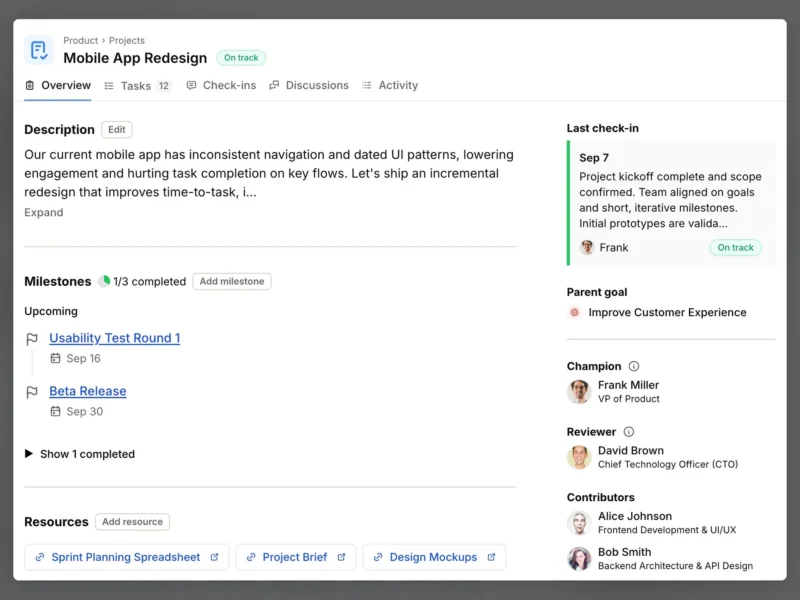
- Projects with a champion. Every project has an owner, milestones, and a check-in rhythm, and the project page collects the description, milestones, resources, parent goal and the people involved in one view.
- Async check-ins instead of status meetings. Contributors post progress updates on a cadence the tool enforces, and those updates are what feeds the goal progress above them.
- Team spaces. Departments get their own home for goals, projects and documents instead of a single flat workspace everyone shares.
- Message boards, documents and files. Discussions and written material live beside the work rather than in email threads and a separate drive.
- People and permissions. Members, roles and the organisation structure are managed inside the app, with a champion and reviewer per project.
- Programmatic access. A CLI and an API let scripts and agents create goals, update projects and post check-ins, and the project publishes agent skills for coding assistants on top of that.
Running it yourself
The documented self-hosting route is a single-host release archive: download operately-single-host.tar.gz from the latest release, extract it, run ./install.sh, then bring the stack up with docker compose up --wait --detach. The install guide on the project site covers the details, and the repository ships development setup documentation for anyone who wants to build from source instead.
Because it is a Docker-based server application, the practical requirement is a host with Docker and Compose rather than a desktop operating system. A hosted cloud version of the same product is offered for teams that would rather not run it themselves.
Licence and edition
Operately is open source under the Apache License 2.0, and the full product is what you get when you self-host. The repository carves out one exception worth knowing about: the contents of the ee directory are licensed separately under the Operately Enterprise Edition licence, the usual open-core arrangement where the core application is permissively licensed and some enterprise-only code sits beside it.
Where it fits in the directory
If you want a conventional tracker rather than an opinionated system, Leantime and Kaneo are lighter-weight open source alternatives, and Plane covers the Jira-style issue-tracking end of the same shelf. Operately is the one to look at when the goal tracking is the point and the tickets are downstream of it.
Who it suits
Small and mid-sized organisations, typically a few dozen people, that want goal alignment without buying a per-seat SaaS product or assembling their own process out of a blank-canvas wiki: startups, consultancies, nonprofits and teams in regulated environments that need the data to stay on their own infrastructure.