Convoy
- Platform
- Docker Linux
- Licence
- Elastic License 2.0
- Website
- getconvoy.io
- Source code
- github.com/frain-dev/convoy
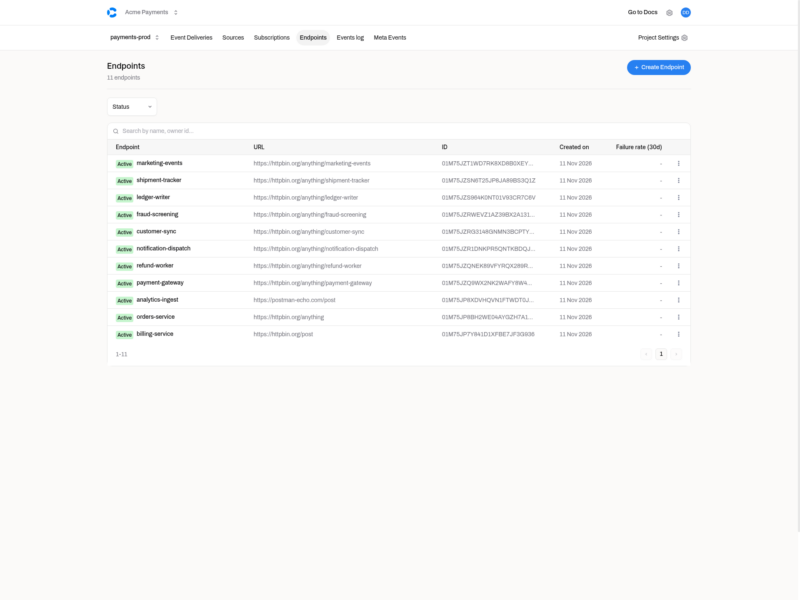
Convoy is a self-hosted webhooks gateway: it sits between the services that emit events and the servers that receive them, and takes over the parts of webhook delivery that are tedious to build yourself — retries, signatures, rate limits and a record of every attempt. It is written in Go, ships as a single binary or a container image, and includes a browser dashboard for projects, endpoints, subscriptions and the event log.
The model is straightforward. A project groups your endpoints; an endpoint is a destination URL with its own secret and retry behaviour; a subscription decides which event types reach which endpoint; and every event that arrives is stored along with its delivery attempts, so a receiver that was down at 3am can be inspected and replayed instead of guessed at.
What it handles for you
- Retries on a configurable schedule with exponential backoff, so a flaky receiver does not silently lose events
- HMAC signature verification on incoming events, with a secret per endpoint
- Per-endpoint rate limiting, plus a circuit breaker that stops hammering a destination that is down — dead endpoints are tracked separately
- Event replay, manual retries and a searchable delivery log carrying request and response bodies
- Filters that route only the matching event types to a given endpoint
- Incoming sources beyond plain HTTP, including message brokers such as SQS, AMQP and Kafka
- A CLI and a REST API that expose everything the dashboard does
Running your own instance
Convoy needs PostgreSQL and Redis. The project publishes container images and a compose file for a local install: the documented quick start is a one-line installer, and the manual route is docker compose -f configs/local/docker-compose.yml up from a clone of the repository, which brings up Postgres, PgBouncer, Redis and Convoy itself (web, worker and the migrations job) and seeds a default login. A smaller test can run the binary directly against a JSON config file, with the schema applied by the bundled migrate command.
Licence
Convoy is not OSI open source. The code is published under the Elastic License 2.0, which makes the source available and permits most uses but forbids offering it to others as a hosted service. The community edition is free to self-host with the vendor’s limits of one user, one organisation and two projects; advanced endpoint management, advanced subscriptions and SSO are sold as paid features. Read the licence and pricing terms before putting it in front of customers.
Alternatives
Svix is the closest permissively licensed equivalent: MIT licensed, self-hostable, and aimed at the same job of delivering webhooks reliably. If you only need queued retries rather than a full gateway, a general-purpose job queue will do the work with more wiring. You can also browse the rest of the open source directory for related tools.