Atheos
- Platform
- Web Docker
- Licence
- MIT Open source
- Website
- atheos.io/
- Source code
- github.com/Atheos/Atheos
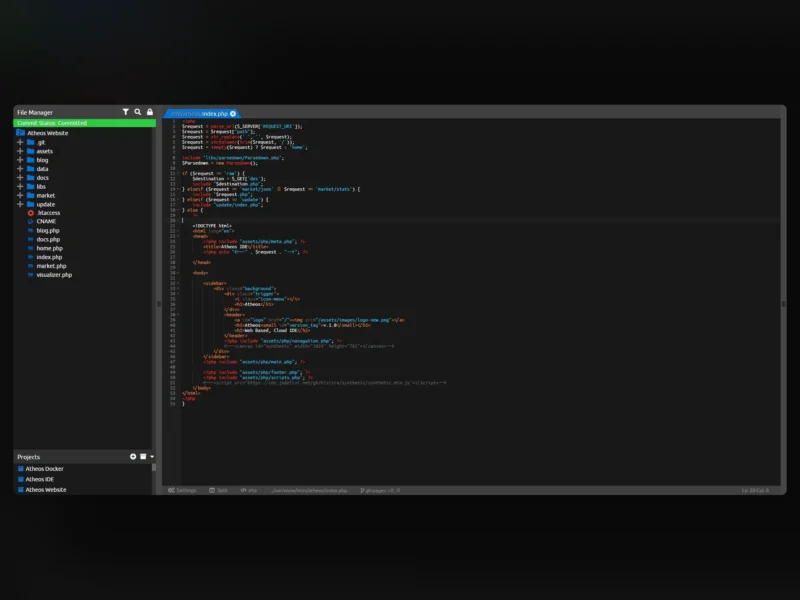
Atheos is a self-hosted, browser-based IDE: drop it on a web server that runs PHP and you get a full code editor in any browser tab, with no database and no desktop client to install. It is a continuation of the Codiad IDE and is maintained by Liam Siira.
The layout will be familiar to anyone who has used a desktop editor: a file and project manager on the left, split editor panes in the centre, and a right-hand panel for system and plugin controls. Because the editor lives on the server, the same files are reachable from a laptop, a Chromebook or a borrowed machine that has nothing installed.
Key features
- Split editor panes, 20+ colour themes and syntax highlighting for 40+ languages
- Multiple user accounts on one install, each with its own projects
- Real-time collaborative editing over the same workspace
- Plugin library and marketplace — CodeGit, Macro Editor and the marketplace browser ship this way
- Advanced search across the workspace, plus error checking and inline notifications
- LocalStorage redundancy and quick-download backups of project files
- Interface translations through i18n language files
Requirements and installation
Atheos needs only a web server with PHP and a Unix-style filesystem; the documentation carries configuration examples for Apache 2 and Nginx, and quick-install walkthroughs for Ubuntu and CentOS. There is no database. Unpack or clone the source into a web-accessible directory, make config.php, data, workspace, plugins and themes writable, then open the URL: a setup screen creates the first account, project and timezone. The project warns that Windows WAMP installations tend to hit pathing problems, and that the marketplace additionally wants allow_url_fopen plus the ZIP, OpenSSL and mbstring extensions, none of which are required for the editor itself.
A Docker image is published, which is the quickest way to try it: docker run --rm -p 8080:80 -d hlsiira/atheos:latest, then open port 8080.
What it is not
Atheos is a lightweight editor rather than a Language Server-backed IDE. Completion is basic, debugging and terminal access are absent or plugin-provided, and very large repositories are better served by a full desktop editor with local tooling. What it does well is give a small team a shared coding environment on a server they already run, with nothing to install on the client side.