seelf
- Platform
- Web Docker Self-hosted
- Licence
- GPL-3.0 Open source
- Website
- yuukanoo.github.io/seelf/
- Source code
- github.com/YuukanOO/seelf
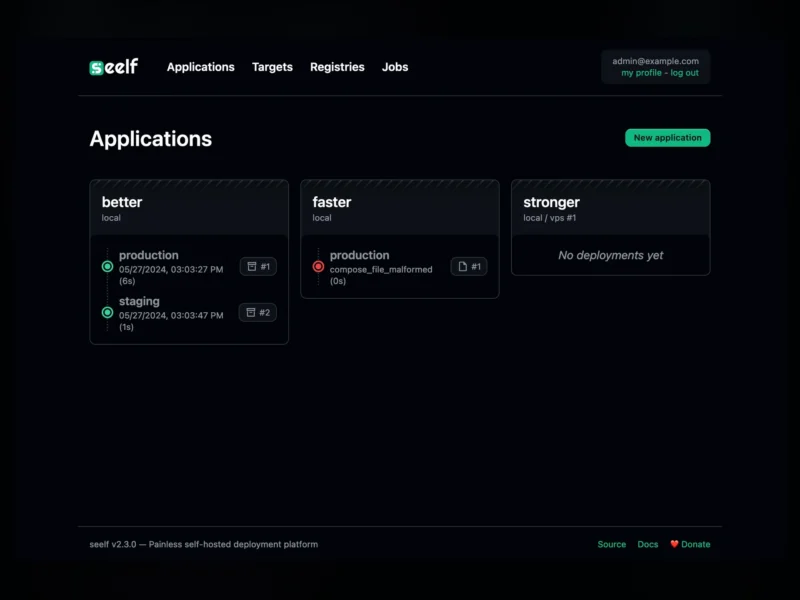
Overview
seelf is a self-hosted deployment platform: point it at a working compose.yml and it deploys the stack on a target host, exposes the services you choose on their own subdomains and manages the certificates in front of them. It sits in the same slot as Dokku, CapRover, Coolify and Heroku — a small control panel that turns a compose file into a running environment without a hand-written deploy script.
The whole product is a Go binary with the web dashboard baked in, and Compose and Git ship inside it, so a host only needs a Docker engine. Data — the SQLite database, its configuration file and deployment artefacts — lives in a single /seelf/data directory you can back up.
What it does
- Compose in, deployment out — reads a compose file, deploys every service and wires up only the ones you mark for exposure, so a stack that works locally needs no rewrite.
- Targets with an automatic proxy — a target is a host where deployments land; seelf can deploy and configure a Traefik proxy on it, generate URLs from the target domain and the service name, and issue certificates for HTTPS, or leave exposure entirely manual.
- Production and staging as first-class environments — each application environment can sit on a different target with its own variables, and changing an environment triggers a redeploy while cleaning up the old target’s resources.
- Several exposed services per application — the first service alphabetically takes the default subdomain and the rest hang off it, which covers a frontend plus API plus worker stack in one application.
- Git sources and CI/CD — deploy from a repository and drive it from a pipeline through the HTTP API instead of clicking through the dashboard.
- Private images — Docker registries can be configured when a stack needs an image that is not public.
- Jobs and deployment history — builds, deployments and cleanups run as queued jobs with their logs, and every application lists its past deployments with status, environment and duration.
- Light footprint — one small container plus whatever you deploy, rather than a Kubernetes distribution, which is the point on a modest VPS.
Deployment and requirements
seelf itself is installed as a container: docker run with the Docker socket mounted and a volume on /seelf/data, or the equivalent compose file with docker compose up -d. Docker 18.0.9 or newer is the only dependency on that path, because Compose and Git are bundled. Building from source needs Go 1.21 or newer and Node 1.18 or newer.
Configuration comes from a YAML file, environment variables, or both — variables win — and covers the data path, HTTP host and port, TLS and log format. On first start the container creates the admin account from ADMIN_EMAIL and ADMIN_PASSWORD if no user exists yet.
Scope worth knowing before planning around it: Docker is the only provider today (Podman, Swarm and Kubernetes are on the roadmap), only production and staging environments are managed, and one target per host is allowed.
Who it is for
Self-hosters and small teams who already write compose files and want the deploy, the proxy and the TLS handled without adopting a full platform. If you need many environments, several providers or multi-user roles, a larger PaaS is the better fit.
A close relative in the directory: Coolify, a bigger self-hosted PaaS that also drives Docker and Compose.