Mergeable
- Platform
- Web Self-hosted
- Licence
- MIT Open source
- Website
- usemergeable.dev
- Source code
- github.com/pvcnt/mergeable
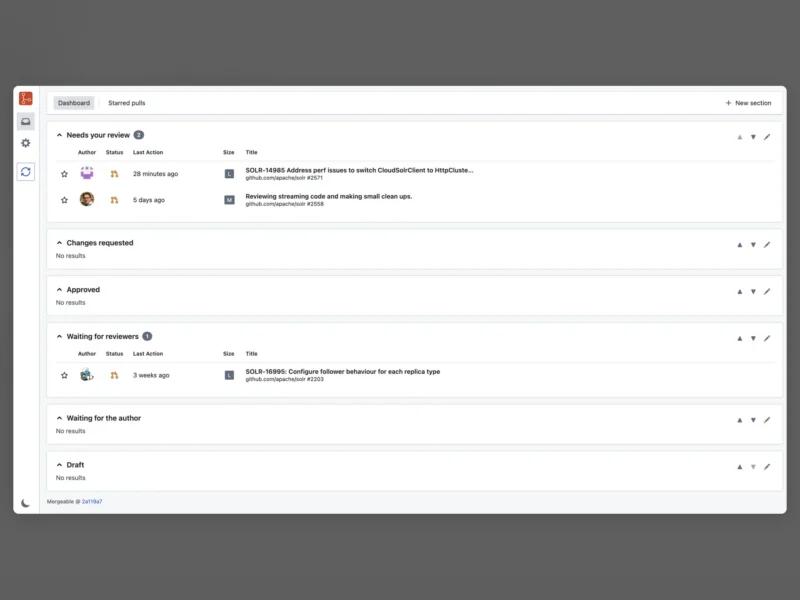
Overview
Mergeable is a better inbox for GitHub pull requests. Instead of scrolling a flat list of “review requested” notifications, you define sections with GitHub search queries — needs your review, changes requested, approved, waiting on the author, drafts — and every pull request lands in the right section automatically. Each section refreshes with its own query, so the inbox reflects whatever you consider worth watching across all your repositories at once.
It is a browser application with no server side: your token and your layout stay in the browser’s local storage, and nothing is proxied through somebody else’s backend. There is a public instance if you just want to try it, and the source is small enough to build and host yourself.
What it does
- Sections from search queries — any GitHub pull-request search becomes a section, so “review-requested:@me”, a label, a milestone or a repository list can each get its own column.
- Attention set — pull requests where it is your turn to act are highlighted, so the next thing to do is visible without reading every row.
- Multiple GitHub instances — connect to github.com and to GitHub Enterprise hosts from the same inbox.
- Local by design — all data lives in browser storage; there is no account, no sync service and no intermediate server holding your access token.
- No GitHub app required — it talks to the API with a token you provide, so nothing has to be installed into an organisation.
- Keyboard-first navigation — shortcuts for moving between sections and opening pull requests.
- Simple operation — a static build with no database and no background workers, so hosting it costs nothing beyond serving files.
Deployment and requirements
The quickest path is the public instance at app.usemergeable.dev, where you supply a personal access token and start adding sections. To run your own, the project is a pnpm and Turborepo workspace built with Vite: clone the repository, install with pnpm, and pnpm run dev serves it locally for development; the documentation at usemergeable.dev covers self-hosting your own instance. Because everything is client-side, “self-hosting” means serving static files — no database, no migrations, no worker process.
The trade-off of that design is worth stating plainly: your configuration and token live in one browser profile. Signing in on a new machine, or clearing site data, means setting the token and the sections up again. A token with read access to the repositories you follow is enough to review; anything that acts on a pull request needs a token with the corresponding scopes.
Mergeable is open source under the MIT licence, with the full source on GitHub.
Who it is for
Maintainers and reviewers who own several repositories, or who work across a company’s GitHub Enterprise and the public github.com, and who want one page that answers “what needs me now”. It also suits anyone who finds GitHub’s notification inbox too coarse: sections are just queries, so the view is as narrow or as broad as you make it. If your team lives in GitLab or a self-hosted Gitea/Forgejo instance instead, this is not the tool — it speaks GitHub’s API only.