MetaGPT
- Platform
- Linux macOS Windows Docker
- Licence
- MIT Open source
- Website
- docs.deepwisdom.ai/main/en/
- Source code
- github.com/FoundationAgents/MetaGPT
MetaGPT is a multi-agent framework that hands a group of LLM agents the roles and the paperwork of a small software company. A product manager, an architect, a project manager and an engineer each get their own standard operating procedure, take a one-line requirement as the brief, and work through it in sequence until there is a repository at the end. The authors reduce the idea to a formula — Code = SOP(Team) — and the outputs are the artefacts a human team would leave behind: user stories, a competitive analysis, requirements, data structures, API specifications, design documents and the code itself.
What a run produces
Give it metagpt "Create a 2048 game in HTML with arrow-key control" and the team starts writing. Alice, the product manager, saves the requirement and produces a PRD; Bob, the architect, turns that PRD into a system design with API definitions and sequence diagrams; Eve, the project manager, splits the design into ordered tasks with dependencies; and Sam, the engineer, implements the files one at a time, with a review pass that rewrites each file before it is saved. Everything lands in a fresh git repository under the project workspace, so the PRD, the design, the task list and the source code are all still there to inspect afterwards instead of scrolling past in a chat window.
Roles, SOPs and the shared environment
Agents do not call each other directly. They publish messages through an Environment, and each role subscribes to the message profiles it acts on, which is how the team coordinates without a hard-coded script. Roles are ordinary classes you can instantiate yourself; a Team is given an investment budget and an idea and runs until the work is done. Custom specialists are built from an action class — a prompt template, an output parser and a run() method — so the software-company roles, the researcher and the debate agents are all built on the same primitive you would use for your own team.
Beyond code: Data Interpreter
Data Interpreter covers work that is not a codebase. It writes Python, runs it in a Jupyter kernel, reads the error when something fails and tries again, so a request for an analysis or a chart comes back as executed results rather than a description of the steps. That observation-and-retry loop is the same one the engineer uses, applied to data: load the file, fix the parse, plot the result, report what the numbers actually are.
Running it
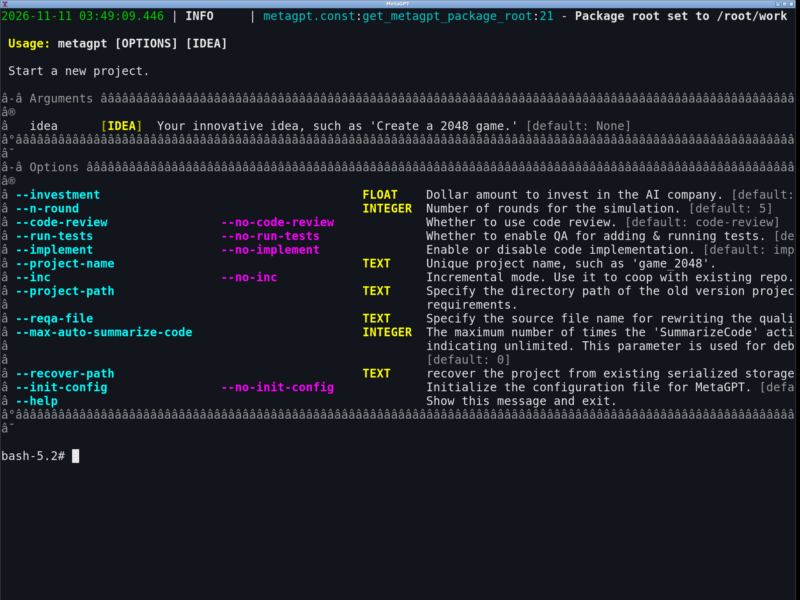
MetaGPT needs Python 3.9 to 3.11, plus node and pnpm if the generated project has a web front end. Models are configured once in ~/.metagpt/config2.yaml, which metagpt --init-config writes for you: point it at OpenAI or any OpenAI-compatible endpoint, or at Azure, Ollama or Groq, and the same configuration drives every role. The CLI takes --investment, --n-round and --project-name, with switches for code review, tests and implementation, and an official metagpt/metagpt image is published on Docker Hub. Budget for it: the project documentation quotes roughly $0.20 of GPT-4 spend for an analysis-and-design run and about $2 for a full project with code.
Project and lineage
MetaGPT comes from the ICLR 2024 paper on meta programming for multi-agent collaboration, and the research line continued — AFlow, the team’s workflow-generation work, was an ICLR 2025 oral. The commercial product built on it is MGX (mgx.dev); the open-source framework is where the SOPs can be read and run. Development has slowed rather than stopped: the latest tagged release is v0.8.2 from March 2025 and the last commit on main arrived in January 2026, so expect a settled codebase rather than weekly churn. The code is MIT licensed and lives at github.com/FoundationAgents/MetaGPT — the repository moved away from the geekan account that PyPI metadata and most tutorials still point at.
Alternatives
- AutoGen — a multi-agent conversation framework from Microsoft Research, now archived in favour of Microsoft Agent Framework
- LangGraph — graph-based orchestration for agent workflows where you define the control flow yourself
- gpt-engineer — the minimal version of the same idea: one prompt in, a codebase out
- OpenHands — a ready-made software engineering agent rather than a framework to build on
- Aider — a terminal pair-programmer that edits an existing repository instead of generating a new one