Minne
- Platform
- Docker Linux Web
- Licence
- AGPL-3.0 Open source
- Website
- minne.stark.pub/
- Source code
- github.com/perstarkse/minne
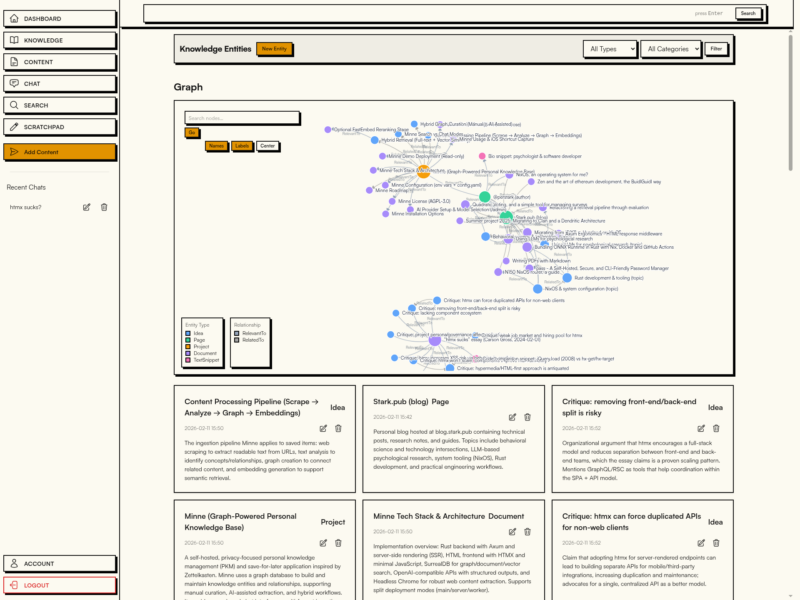
Minne (Swedish for “memory”) is a personal knowledge base and save-for-later application that stores everything you capture in a graph database and works out the connections between ideas for you. Instead of relying on manual backlinks the way Logseq or Obsidian do, Minne extracts entities from what you save, proposes relationships between them, and lets you approve, edit or ignore each suggestion. It is written in Rust, renders server-side, and runs as a single self-hosted web app.
Key Features
- Search and chat — full-text search when you know what you are looking for, or a chat mode that reasons across your whole knowledge base
- Hybrid retrieval — vector similarity combined with full-text search, with an optional FastEmbed reranking stage for better answers
- Manual and AI-assisted connections — build entities and relationships by hand, let the AI do it, or approve its suggestions one by one
- Visual graph explorer — an interactive D3 graph for navigating entities and their relationships
- Multi-format capture — ingest text, URLs, PDFs, audio files and images into the same store
- Scratchpad — dump quick thoughts and promote them to permanent content when they are ready
- Any OpenAI-compatible model — point it at OpenAI, or at a local model through an OpenAI-compatible endpoint
- Self-hosted and private — your notes and their embeddings stay in your own database
Why Use Minne?
The appeal is capture without friction. Saved links, PDFs and notes are scraped, analysed and embedded automatically, so the knowledge graph fills itself in while you keep working — and because every AI-suggested link stays reviewable, you keep the structure you actually want rather than a black box. Under the hood it is Rust with server-side rendering and HTMX, which makes it light enough to sit on a small home server next to its SurrealDB instance.
Use Cases
- Research notes that need to be searchable and cross-referenced
- A read-it-later queue that turns into a connected knowledge base
- Personal wikis for projects, essays and reading
- Chatting with your own collected material instead of the open web
Deployment
The quickest route is the repository’s Docker Compose file, which brings up Minne together with SurrealDB and Chromium: clone the repo, set your API key, then docker compose up -d and open port 3000. Nix, prebuilt binaries and building from source are also documented. Minne needs a SurrealDB instance (address, user, password, database and namespace) and an OpenAI-compatible API key; everything else, including the optional reranker, is configurable through environment variables or a config.yaml. A read-only demo is available at minne.stark.pub.
Licence
Minne is free and open source software released under the GNU Affero General Public License v3.0. Because the AGPL covers network use, anyone offering a modified Minne as a service must publish their changes.