Tautulli
- Platform
- Docker Linux Windows macOS Web
- Licence
- GPL-3.0 Open source
- Website
- tautulli.com
- Source code
- github.com/Tautulli/Tautulli
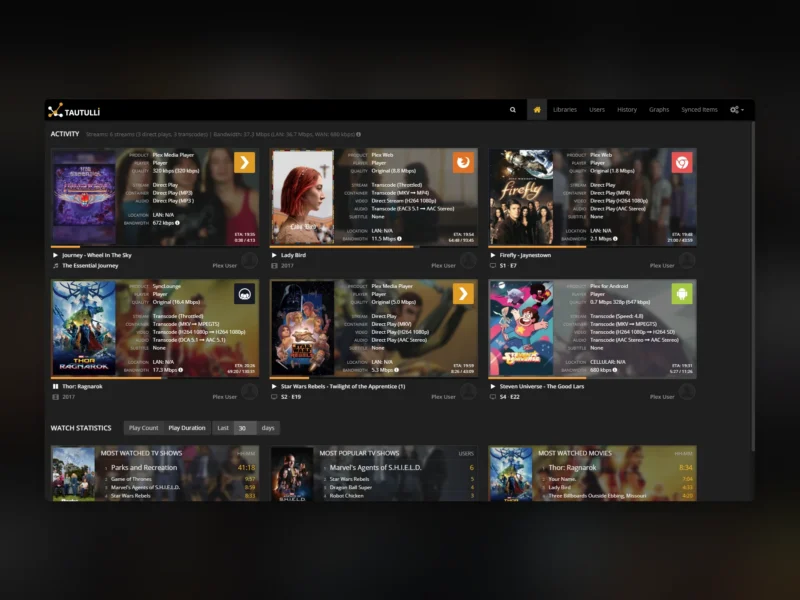
Overview
Tautulli is a self-hosted web application that monitors and analyses a Plex Media Server. It keeps its own database of everything played — sessions, users, libraries, stream types, bandwidth — and presents it as live activity, searchable history, per-user and per-library statistics, and graphs. It is written in Python, distributed under the GPL-3.0 licence, and ships as a Docker image, a snap, Windows and macOS installers, or from source.
Plex itself shows what is streaming right now and very little else. Tautulli records the detail behind each play (direct play, direct stream or transcode, container and codec, player, LAN or WAN) and keeps that record across library rescans and metadata refreshes, so the history stays comparable over time.
Key Features
- Live activity dashboard — every active stream with user, player, location, codec, direct-play/transcode status, progress and total server bandwidth, plus a snapshot of current streams.
- Global watch history — a searchable, filterable, sortable record of every play, grouped by media item.
- Users and per-user detail — watch statistics per account, with devices and IP addresses and comparison across users.
- Library statistics — per-library play counts and durations, most watched and most popular titles over a selectable window such as the last 30 days.
- Graphs and analytics — daily and weekly play counts and durations, split by direct play, direct stream and transcode.
- Notifications — per-event agents for Discord, Telegram, Slack, Pushover, Gotify, ntfy, email, MQTT, webhooks, scripts, Microsoft Teams and several more, with custom conditions and per-user rules.
- Newsletters — scheduled HTML emails of recently added media, sent to users or published as a shareable newsletter page.
- Recently added and sync lists — what landed on the server lately, and which users have items synced to their devices.
- Data exporter — writes the collected history to CSV or JSON so it can be archived or migrated.
- API — a documented v2 API exposes activity, history and library data to scripts and dashboards.
Why Use Tautulli
Plex answers “what is playing now”; Tautulli answers “what was watched last month, by whom, and how”. For a shared server that is the difference between guessing who uses the box and knowing: which libraries nobody opens, which accounts transcode everything, which titles justify the storage they occupy. Because the data lives in Tautulli’s own database rather than in Plex, the answers survive rescans, metadata fixes and re-imports, and they can be exported before a migration.
Use Cases
- Shared household or friends-and-family servers — see who watches what, and settle arguments about which library is actually used with data instead of impressions.
- Storage and curation decisions — find unwatched content before buying more disks, and identify the titles worth keeping.
- Transcoding and bandwidth diagnosis — see which clients and users force transcodes, and how much upstream bandwidth the server is really using.
- Input for automation — expose the history through the API or notifications so cleanup and request rules act on real viewing behaviour.
Requirements and Installation
Tautulli needs Python 3.10 or newer and a Plex Media Server it can read from; the first-run setup asks you to sign in to Plex so it can fetch the server token. Installation options are a Docker image (tautulli/tautulli, publishing the internal port 8181), sudo snap install tautulli on most Linux distributions, Windows and macOS installers from the GitHub releases, FreeBSD packages, or running from source. The web interface then listens on http://localhost:8181. Releases move through master (stable), beta and nightly tracks, so pin the track you have tested.
Related: Jellyfin is the open source media server alternative, and Jellystat provides the equivalent statistics dashboard for Jellyfin. Ombi handles media requests for the same stack.