Lingarr
- Platform
- Docker Linux Web Self-hosted
- Licence
- AGPL-3.0 Open source
- Website
- lingarr.com
- Source code
- github.com/lingarr-translate/lingarr
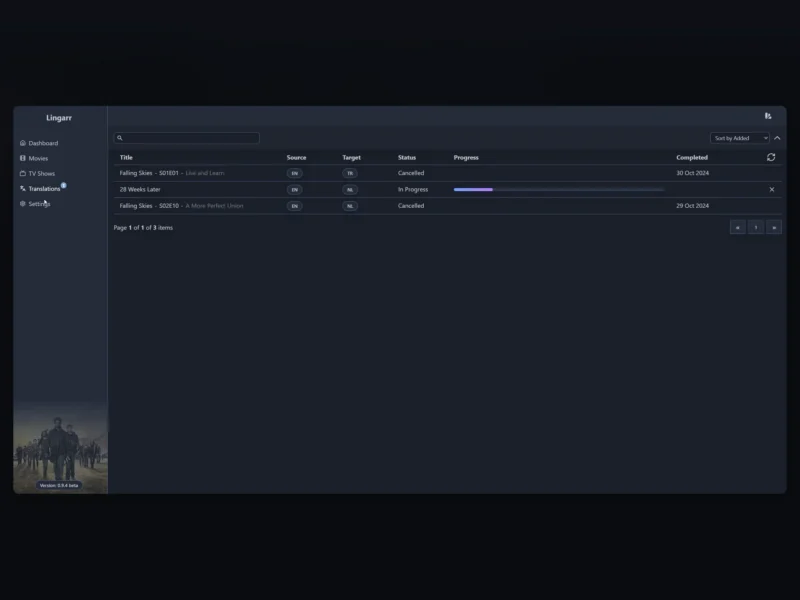
Lingarr is a self-hosted web application that translates subtitle files for a movie and TV library automatically. It connects to your media manager, inventories the subtitle files that already exist, and produces translated versions in the languages you ask for — writing the new .srt files next to the originals so the player picks them up without any further work.
Key Features
- Many translation services, one queue — LibreTranslate for a fully local, offline-capable setup; DeepL; and AI services including OpenAI, Anthropic, Gemini, DeepSeek, Mistral and xAI, alongside Google, Bing, Yandex and Microsoft translation. A local AI endpoint (Ollama or any OpenAI-compatible server) keeps the text on your own hardware.
- Fallback chains — services are tried in the order you define, so a rate limit or an outage on the primary does not stall the queue; the next service picks the job up.
- Automated background jobs — translations run as queued jobs with configurable concurrency, retry and timeout settings, and each movie or episode shows its own status and progress in the web interface.
- Batch translation and proofreading — AI services can translate a subtitle in batches for speed and cost, and an optional second pass proofreads the result against the source line by line.
- Media manager integration — connect your library with an API key and Lingarr keeps an inventory of every movie and episode, showing which subtitles exist in which language and which translations are pending, running or done.
- Deploys anywhere — multi-architecture Docker images for AMD64 and ARM64, a configurable URL prefix for reverse proxies, and a choice of MySQL, PostgreSQL or SQLite for storage.
Why Use Lingarr
Subtitle coverage is usually uneven: a show arrives with English audio and English subtitles, but the household watches with Dutch, German or Turkish captions. Downloading each missing subtitle by hand does not scale past a few hundred episodes, and machine-translating them one by one is worse. Lingarr turns that into a queue — point it at the library, choose the languages, and let it work through the backlog while reporting progress. Because the translation backend is a setting rather than a dependency, the same installation can start on a free local engine and move to an AI model when quality matters more than throughput, and each service can be swapped for a fallback without touching the library.
Use Cases
- Multilingual households — keep one library and generate captions for every language the family actually watches in.
- Filling gaps in an existing collection — pair it with Bazarr, which fetches the subtitles that exist, and let Lingarr cover the languages no provider has.
- Fully offline setups — LibreTranslate or a local AI model on the same host translates without sending a line of dialogue to a third party.
- Large libraries — the job queue, retry logic and per-item progress make a thousand-episode backlog something you start once and check later.
- Private streaming servers — publish the translated subtitles straight into a Jellyfin or Plex library served from your own hardware.
Requirements
Lingarr is distributed as a Docker image (also available from the GitHub Container Registry) and needs read/write access to the media folders, because translated subtitle files are written back next to the source files. A media manager such as Sonarr provides the library inventory, and the storage backend can be MySQL, PostgreSQL or SQLite — the last of which makes a single-container install possible. Translation runs through whichever service is configured, so an API key or a reachable LibreTranslate/local-AI endpoint is required before the first job can be queued.