FOSS Face-Off: Mainsail vs Fluidd vs OctoPrint — 3D Printer Control Panels Compared
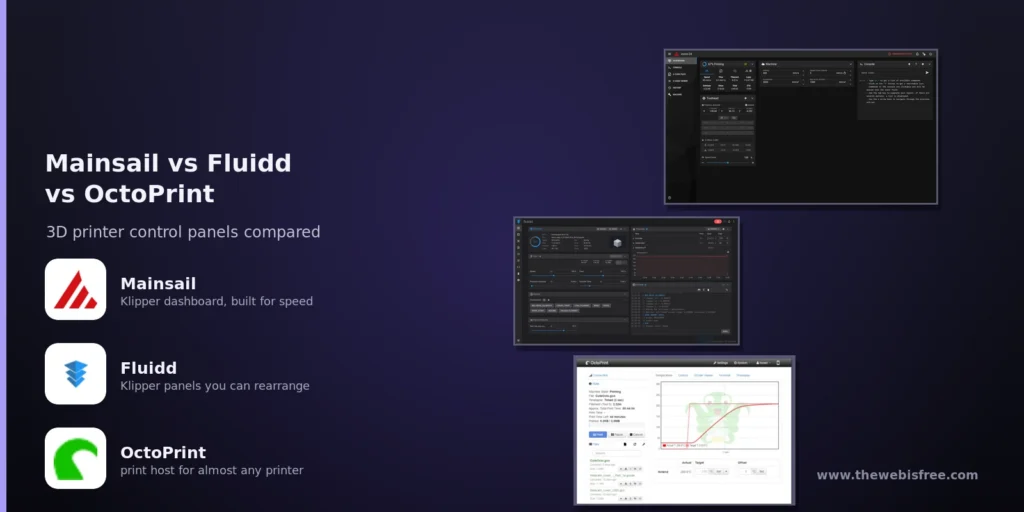
If your 3D printer is on the network, the next question is what you talk to it with: Mainsail, Fluidd or OctoPrint. They look similar in a screenshot and answer very different questions.
The split is firmware. Klipper has no interface of its own — it exposes a control API and leaves the screen to someone else. Its installation guide names the front-ends: “The two main Moonraker-based front ends are Fluidd and Mainsail.” OctoPrint is the other kind of program: a print host that owns the printer connection, runs the job, and presents itself as a web page.
Mainsail — the fast Klipper dashboard
Mainsail is a Vue application that talks to Moonraker, aiming to make Klipper more accessible with a lightweight, responsive interface. It never speaks to the printer directly; Klipper and Moonraker do that, and Mainsail is the pane of glass in front of them.
- Klipper-native control — real-time control and live monitoring of temperatures, progress and printer state.
- Dashboard organisation — arrange the panels you actually use.
- Deep theming — built-in and community themes, backgrounds, custom CSS, replaceable logos and icons.
- Macro management — prompts and presets, so a macro can ask for input instead of needing a config edit.
- Print history and multi-printer management from one install.
- Many install routes — MainsailOS (Raspberry Pi and some Orange Pi boards), KIAUH, Docker or manual setup.
Mainsail is GPL-3.0; latest release v2.19.0 (27 August 2026).
Fluidd — the dashboard you rearrange
Fluidd solves the same problem with a different emphasis: a panel grid you move around yourself. It ships as static files served by Moonraker, or from an official Docker image.
- Responsive UI — desktop, tablet and mobile from one install.
- Customisable layouts — every panel can be repositioned.
- Built-in colour themes with dark mode, so you are not writing CSS to be comfortable.
- G-code viewer with object exclusion, plus thermal charts and presets.
- Multi-webcam support (MJPEG, HLS, WebRTC) and a diagnostics dashboard.
- Third-party integrations — Kalico, Happy Hare, AFC, Beacon, Obico, OctoEverywhere and more.
Fluidd is GPL-3.0; latest release v1.37.7 (16 October 2026).
OctoPrint — the print host
OctoPrint is older, larger and a different category of software. It holds the printer connection and runs the job, extended through plugins — “the snappy web interface for your 3D printer”, by Gina Häußge.
- Full remote control — jobs, temperatures, movement and an embedded webcam feed in the browser.
- A plugin repository — plugins.octoprint.org lists 14 power-control and 15 remote-access plugins before you reach camera, notification and workflow add-ons.
- GCODE scripts and custom controls — hooks for things the UI never shipped with.
- REST API — everything the interface does is reachable over HTTP, which is what makes farm automation realistic.
- Runs almost anywhere — OctoPi for a Raspberry Pi, Octo4a for Android, or Docker on any Linux box.
OctoPrint is AGPL-3.0. Stable release 1.11.8 (23 June 2026); 2.0 release candidates are in testing.
Head-to-Head Comparison
Klipper or any other printer
This is the decision that matters. Mainsail and Fluidd are written for Klipper and Moonraker and will not drive a printer that does not run Klipper. OctoPrint attaches over a serial connection and speaks G-code, so it works with Klipper as well as with printers that never left stock firmware.
Plugin and extension ecosystem
OctoPrint wins outright: a curated plugin repository, a documented plugin API and a decade of community plugins. The Klipper front-ends have no plugins of their own; extensibility comes from Moonraker, Klipper macros and named integrations.
Performance on a Raspberry Pi
The Klipper front-ends are static bundles: the board serves a few files, Moonraker answers API calls, your browser draws. OctoPrint is a Python application holding the connection and running your plugins, so the same board does far more work — qualitative, not a benchmark, but it is why the front-ends feel instant on modest hardware.
Mobile and tablet use
All three are responsive and usable from a phone; Fluidd adds keyboard shortcuts. On a wall tablet the difference is layout: Fluidd lets you arrange panels, Mainsail gives you a dashboard you theme.
Setup effort
None is hard — OctoPrint via OctoPi, Mainsail via MainsailOS, Fluidd via KIAUH or Docker. The real work is Klipper configuration, not the interface.
Themeability
Mainsail is the most customisable: themes, backgrounds, CSS, logos and icons. Fluidd ships colour themes with dark mode and rearranges panels. OctoPrint’s look is largely whatever its plugins give you.
Which One Should You Pick?
Choose Mainsail if: your printer runs Klipper and you want a fast, opinionated dashboard you can restyle.
Choose Fluidd if: your printer runs Klipper, you have a fixed touchscreen, and you would rather move panels than theme them.
Choose OctoPrint if: your printer does not run Klipper, or you need plugins, cameras, notifications or a REST API.
The Bottom Line
Mainsail and Fluidd are the same choice twice: both excellent, both Klipper-only, and the choice between them is layout taste rather than capability. OctoPrint is the different answer — heavier, older, and the only one that will talk to a printer that has not been converted to Klipper. On Klipper, try Mainsail first and move to Fluidd if its layout frustrates you.
Download them at docs.mainsail.xyz, docs.fluidd.xyz and octoprint.org — free, no subscriptions, no account required.
Looking for more? Browse the full directory for free and open source software, or submit a tool we have missed.