Natron
- Platform
- Linux macOS Windows
- Licence
- GPL-2.0 Open source
- Website
- natrongithub.github.io/
- Source code
- github.com/NatronGitHub/Natron
Overview
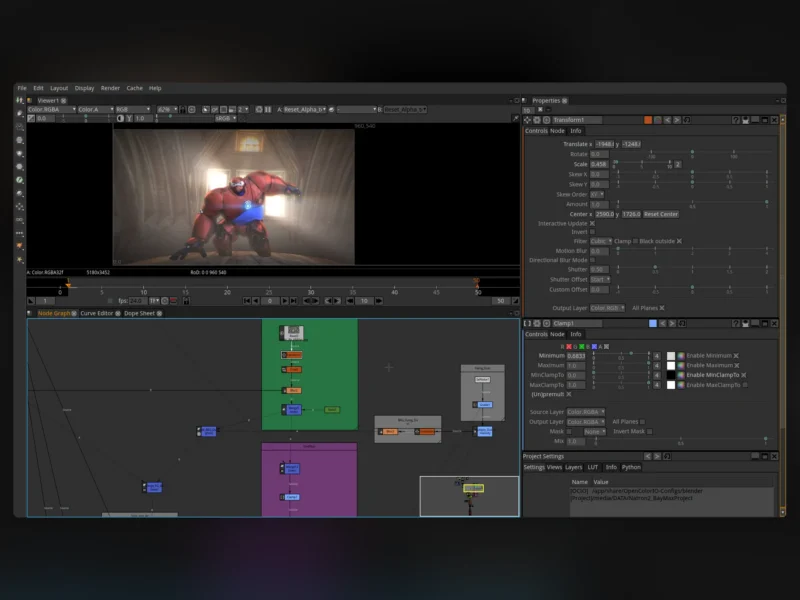
Natron is a free and open-source node-based compositor for visual effects work — the kind of tool you reach for when a shot needs a green screen pulled, a camera move tracked, an object painted out or a matte built by hand. Its author describes it as similar in functionality to Adobe After Effects and Nuke, and that comparison is the honest one: Natron speaks the same node-graph language as Nuke, with MediaIn and Merge nodes, a viewer you A/B between, a curve editor and a dope sheet, rather than the layer-and-timeline model most consumer editors use.
Because everything is a node, complexity stays legible. A shot that would become a stack of nested pre-compositions in a layer-based tool becomes a visible graph: group it, collapse it into a single node, save it as a snippet, reuse it on the next shot. Natron also supports drag-and-drop installation of community-made PyPlugs (Gizmos), so the community toolkit grows without waiting for an upstream release.
The current stable release is 2.5.0, published on 25 November 2022. Upstream development has continued since on the RB-2.6 branch, with 2.5.1 pre-release builds published through 2024, so the project is maintained even though the headline stable version has not moved. The source is licensed under the GNU General Public License v2.0 and developed in the open on GitHub.
Key Features
- Node-based 2D compositing — build a shot as a directed graph of nodes; group, merge and collapse them, and save groups as custom node snippets or presets to share across projects.
- OpenFX plugin support — industry-standard OFX plug-ins load directly, so commercial and free OFX effects, generators and filters can be used inside the graph.
- 2D tracking — a pixel-accurate tracking toolset for stabilising footage and matching motion between elements.
- Rotoscoping — a multi-layered roto toolset with per-vertex feathering, for building mattes around objects frame by frame.
- Keying and matte refinement — chroma-key tools with matte refinement for pulling clean edges from green or blue screen footage.
- Curve editor and dope sheet — full control over keyframes, with interpolation curves for timing and a dope sheet for retiming at a glance.
- Headless rendering — render a project from the command line on a machine with no display, for integration with render farms and distributed network rendering.
- PyPlugs (Gizmos) — drag-and-drop installation of community-made node groups, so custom tools extend the built-in set without patching the application.
Why Use It
Compositing is where free software has historically been weakest. Blender covers 3D and has a compositor, but it is not a dedicated 2D node compositor, and the proprietary options — Nuke, Fusion, After Effects — are either expensive or tied to a subscription. Natron fills that gap with a tool that is genuinely Nuke-shaped: if you have learned the node graph in one, the other feels familiar, and if you work in a mixed studio the vocabulary transfers.
The second reason is its Python layer and headless renderer. Natron projects can be rendered without a GUI, which means a workstation can hand a shot to a farm overnight and the same script can drive batch rendering across a network — the workflow a small VFX team actually needs and the one most free 2D tools do not support. Add OFX support and community Gizmos, and a solo artist on Natron has access to the same plug-in ecosystem as a studio seat.
Use Cases
- Chroma keying — key green-screen footage, refine the matte and composite a replacement background with the Merge and Keyer nodes.
- Set extension and clean-up — paint out rigs, wires and tracking markers, or extend a set beyond what was shot.
- Rotoscoping for VFX shots — isolate a moving element frame by frame with per-vertex feathering, then feed the matte downstream.
- Motion graphics and 2D animation — animatable transforms, blurs and merges driven by curves, for titles and transitions that hold up at any resolution.
- Render-farm compositing — author the graph on a workstation, render headless on farm nodes with no display attached.
- An open post-production pipeline — animate in Synfig Studio, model and render in Blender, composite the passes in Natron, and keep every stage licence-free.
Requirements
Natron publishes builds for all three main desktop platforms. On GNU/Linux it needs an x86_64 distribution with X11, glibc 2.17 or newer and libgcc 4.8 or newer, distributed as an installer, a portable archive or a Flatpak. On Windows it supports 8.1, 10 and 11 on 64-bit x86 hardware, as an installer or a portable build. On macOS the current stable release targets Intel hardware from 10.6 upwards (the site lists 10.6, 10.9 and 10.15 as floors across builds) and runs on Apple Silicon through Rosetta 2, with an alpha native Apple Silicon build available separately. A FreeBSD port is available through Freshports.
Compositing is memory-hungry: complex graphs with large EXR or DPX plates benefit from plenty of RAM and fast disk, and headless renders scale with core count. Download links for every platform, plus past releases and sample projects, are on the project site; community support runs through Discord and the PIXLS.US forum, and bug reports and build guides live on GitHub.
Licence
Free and open source — GNU General Public License v2.0, as stated in the LICENSE.txt file in the project repository. There is no paid tier and no seat counting: use it commercially, modify it, and redistribute it under the same terms.