SuperLocalMemory
- Platform
- Linux macOS Windows
- Licence
- AGPL-3.0 Open source
- Website
- superlocalmemory.com
- Source code
- github.com/qualixar/superlocalmemory
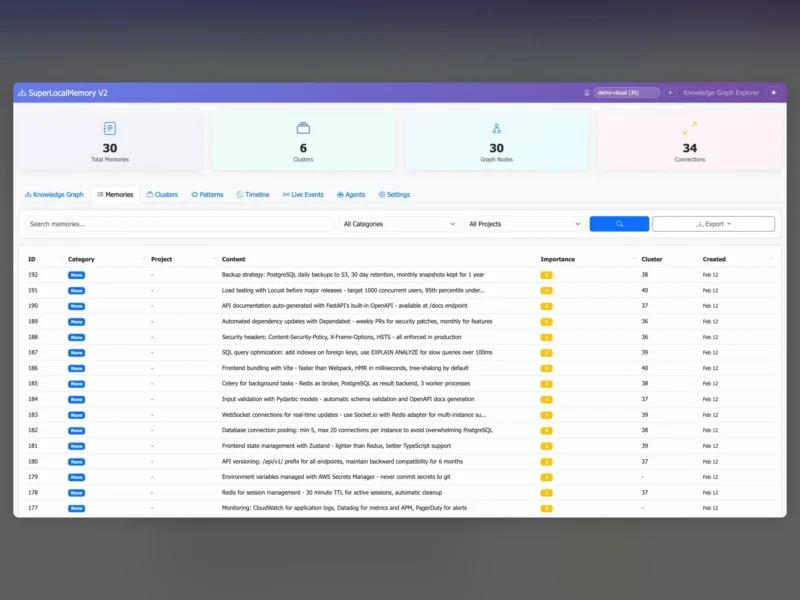
SuperLocalMemory is a governed, local-first memory control plane for AI agents and teams. It gives every agent you use — Claude Code, Codex, Cursor, Copilot, Windsurf, Zed, JetBrains or any harness that speaks MCP — one shared memory that lives on your own machine, and it is deliberately designed to refuse to bluff: when an answer is not in the store, the agent is told “That isn’t in SuperLocalMemory.” instead of receiving a confident guess built on a shallow vector match.
Why it exists
Agents forget everything between sessions. The usual fix — a vector store with a save button — makes the problem worse, because similarity search always returns something, even when nothing it holds actually answers the question. SuperLocalMemory treats memory as a knowledge base rather than a bucket: it records what was saved (who, what, when, and for which project), keeps facts true over time, governs who may see them, and reports honestly when it cannot answer.
Key features
- Three honest recall tiers — a supported answer, up to three closest memories explicitly labelled as such, or an outright “not in memory” refusal. Automatic memory-injection hooks only ever inject supported answers.
- Hybrid retrieval — semantic embeddings, BM25 keyword search, entity-graph traversal, temporal filters, associative (Hopfield) recall, spreading activation and a picture channel, fused and reranked into one result set.
slm traceshows the score each channel contributed. - Nine memory kinds — fact, event, status, opinion, rule, decision, how-to, plan and correction, so “what did we decide” actually favours decisions, and confirmed rules load at every session start.
- Layered recall — depth 0 for a one-line glance, depth 1 for the facts, depth 2 for source, session neighbours, related entities and corrections, with a hard token cap and an
expanddrill-down. - Time travel — ask what was true at a point in time (
--valid-at), what the system knew as of a date (--known-as-of), or restrict to a recent window. - Reviewed corrections —
--replacesretires an old fact without deleting it, and every edit is undoable. - Local knowledge graph dashboard — a browser UI with Knowledge Graph, Memories, Clusters, Patterns, Timeline, Live Events, Agents and Settings views, plus search, category and project filters.
- Prompt-injection defence — recalled text is treated as untrusted evidence: secrets are redacted, forged markers neutralised and provenance attached.
- Pictures and documents (optional) — an on-device EmbeddingGemma 2 model puts text and images in one search space, OCR makes text inside screenshots searchable, and PDFs are indexed page by page with file-and-page citations in every answer.
Installation
The primary routes are npm (npm install -g superlocalmemory) and pip or uv (Python 3.12–3.14), followed by slm setup and slm connect <agent>. A one-line shell installer brings its own Python and configures any AI tool it finds. In Mode A — the default core path — remembering and recalling make no model-provider call at all: no API key, no cloud account and no Docker required. Anything that leaves the machine is opt-in and documented. The optional media pipeline (pictures and PDFs) needs roughly 1.5 GB of models and about 16 GB of RAM.
Requirements
- Node 18+ or Python 3.12–3.14
- macOS, Linux or Windows; the on-device answer-check model (Laya) is Apple Silicon only
- Optional media support: ~1.5 GB of local models, 16 GB RAM
Who it is for
Developers and small teams running several AI coding agents who want shared, private, auditable memory that stays on their own hardware — and who would rather have an honest “I don’t know” than a plausible invention at the bottom of a recall result.
Licence
Open source — GNU Affero General Public License v3.0 (AGPL-3.0), confirmed in the project’s LICENSE file. The network-copyleft terms matter if you plan to expose a modified version as a hosted service.