R2R
- Platform
- Linux macOS Windows Docker Web
- Licence
- MIT Open source
- Website
- github.com/SciPhi-AI/R2R
- Source code
- github.com/SciPhi-AI/R2R
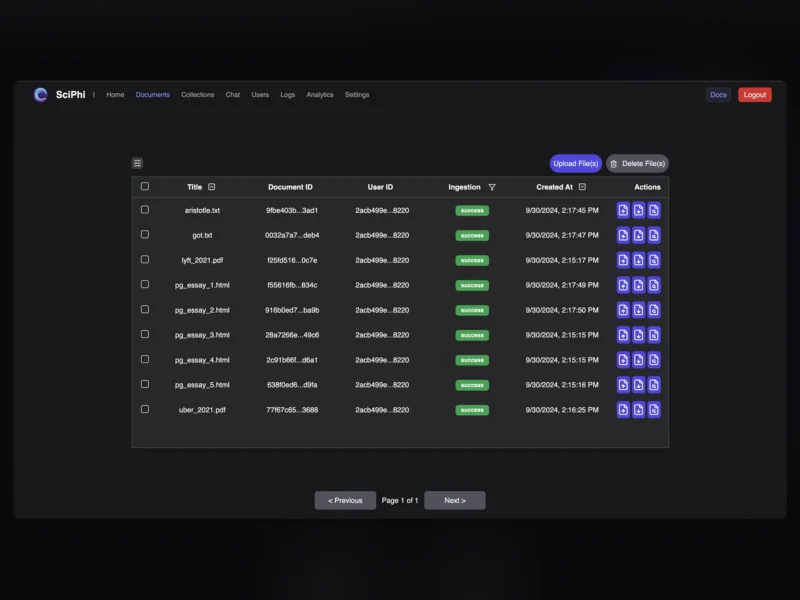
R2R (RAG to Riches) is an open-source AI retrieval system from SciPhi — a production-oriented engine for retrieval-augmented generation that runs behind a RESTful API. You point it at your own documents, and it handles ingestion, chunking, embedding, hybrid search and answer generation with citations, so an application can query a private knowledge base without you assembling a vector database, an embedder, a reranker and a prompt layer by hand. It is meant to be self-hosted: a light mode installs from pip, a full mode runs as a Docker Compose stack with Postgres and pgvector.
Key Features
- Multimodal ingestion — ingests text, PDFs, HTML, Markdown and images, parses them into chunks, and tracks every file as a document object with ingestion status, so you can see what landed and what failed.
- Hybrid search — combines semantic vector search with keyword full-text search and fuses the result sets, which recovers exact identifiers and part numbers that pure embeddings miss.
- Knowledge graphs — extracts entities and relationships from ingested collections and exposes graph-based retrieval alongside vector search.
- Agentic RAG and Deep Research — a retrieval agent plans multi-step research, calls out to the web as well as your own knowledge base, and returns a cited answer; generation parameters such as model, extended thinking and thinking budget are set per request.
- Collections and access control — documents are grouped into collections, users and teams are managed inside the service, and each request is authenticated, so several applications can share one retrieval backend.
- Two SDKs and a REST API — Python (
r2r) and JavaScript/TypeScript clients wrap the same API, and the service ships an application UI for browsing documents, collections, chats, users and ingestion logs. - Observability — per-request logs and an analytics view of retrieval and generation activity are built in, not bolted on.
Licence
Open source — MIT licence, so it can be used commercially and modified freely. Running the full stack needs an OPENAI_API_KEY (or another supported provider) for embeddings and generation, which is a separate cost from the software itself.
Who it is for
Teams building internal search, support assistants or research tools over a private document set, who want retrieval as a service they host rather than a managed vendor. It is heavier than a single-purpose search library — expect to run Postgres and a model provider alongside it.
Alternatives
- AnythingLLM — desktop and Docker app for chatting with your own documents, simpler to start.
- More AI and machine learning tools
Note, October 2026: the project’s hosted documentation site (r2r-docs.sciphi.ai) is currently offline, so the GitHub repository is the canonical source for installation and API reference.