Gogs
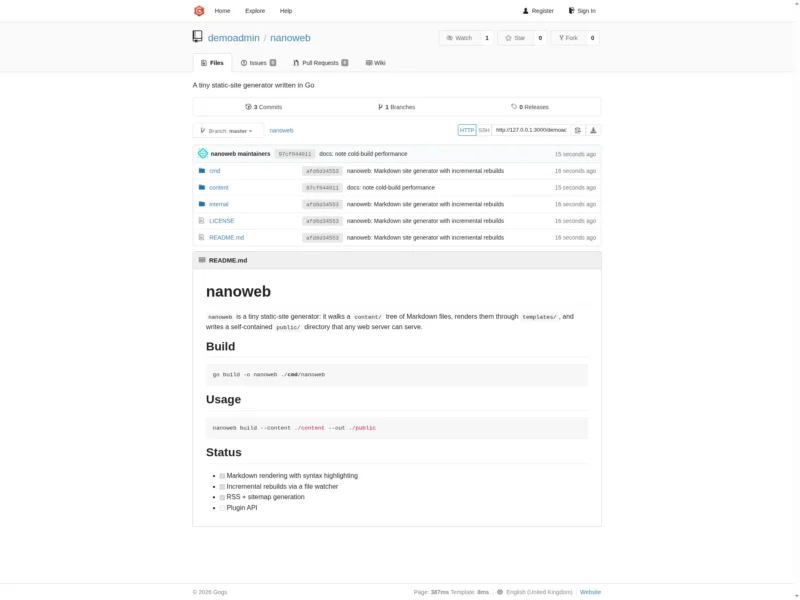
Gogs — “the painless way to host your own Git service” — is a self-hosted software forge delivered as a single Go binary: repositories over SSH, HTTP and HTTPS, issues, pull requests, wikis, organisations, webhooks and a browser editor, all served from a few hundred megabytes of RAM on a Raspberry Pi or a $5 VPS. The project is deliberately minimalist and stable rather than feature-maximal — its stated goal is a simple, stable and extensible Git service that can be set up in the most painless way, with an independent binary distribution for every platform Go supports. Released under the MIT licence, Gogs is at v0.14.3 (June 2026) and needs no language runtime: no Ruby, no Java, no Node, no Python — just the binary and a database file.
Key Features
- One static binary, no runtime — Gogs ships as a self-contained executable, so installation is “download, run, open the browser”. The same build runs on Linux, macOS, Windows and ARM boards.
- Git over SSH, HTTP and HTTPS — clone and push from any Git client, with per-repository deploy keys, Git hooks and Git LFS for large files.
- Four database backends — SQLite3 by default (a single file, perfect for a Pi), or PostgreSQL, MySQL/MariaDB and TiDB when you want a real server.
- Issues, pull requests, wikis and protected branches — labels, milestones, collaborators, comments and review, all in the same forge as your code.
- Organisations and teams — group repositories under an organisation, hand out team permissions, and keep personal projects separate.
- Repository webhooks — Slack, Discord and DingTalk integrations are built in, alongside generic webhooks for anything else.
- Migration and mirroring — import repositories (wikis included) from other code hosts, and keep mirrors in sync from a remote.
- Web editor and file preview — edit files or wiki pages in the browser, with Jupyter Notebook and PDF rendering in the file view.
- Flexible authentication — local accounts plus SMTP, LDAP, reverse-proxy headers, GitHub.com and GitHub Enterprise (with two-factor authentication).
- Tiny footprint, customisable UI — the documented baseline is 2 CPU cores and 512 MB of RAM for a team; HTML templates, static files and 31 translations (Crowdin) can all be overridden.
Why Use Gogs?
Most self-hosted forges ask you to run a stack — a database server here, an application server there, a queue somewhere else. Gogs asks you to run a file. That single property is why it still thrives on hardware that larger forges will not fit on: Raspberry Pis, small VPS instances, NAS boxes and offline/air-gapped machines. Because the binary and the SQLite database are the whole installation, backup is a directory copy, migration is a file copy, and there is no package ecosystem to keep patched beyond the binary itself. The MIT licence makes it frictionless to adopt at work, and the deliberately narrow feature set means fewer moving parts to break: it hosts code, reviews it in pull requests, tracks it in issues and tells your chat tool when something happens. If you need more — Actions-style CI, package registries, federation — its better-known descendants Gitea and Forgejo are drop-in alternatives with a superset of the features; Gogs is the one to choose when the priority is a stable, tiny, boring server that stays up.
Use Cases
- A private Git server for a small team on a Raspberry Pi, an old PC or a $5 VPS.
- A home lab that needs version control for Ansible playbooks, Docker Compose files and dotfiles without a cloud dependency.
- An air-gapped or regulated environment where repositories must never leave the network.
- A teaching or workshop environment: spin up a forge, create accounts, push, open pull requests, throw it away.
- Mirroring and archiving projects you depend on, so an upstream outage does not stop your work.
- Replacing a paid per-seat Git host for a team whose needs are repositories, issues and webhooks.
Similar
- Gitea and Forgejo — the two best-known forks of Gogs; both add built-in CI, package registries and (in Forgejo’s case) federation, at the cost of a larger surface area.
- Sourcehut — a hosted-and-self-hostable forge suite built around mailing-list and patch workflows, with no JavaScript required.
- Tuleap — a full application-lifecycle platform when you need requirements, test management and traceability next to the Git host.
- Gerrit — code review first: a patch-queue forge for teams that gate every change on review.
- GitLab Community Edition — the heavyweight alternative: a full DevOps platform (CI/CD, registry, security scanning) in one self-hosted package, needing considerably more hardware.
Platform
Linux (32-bit x86, x86-64, ARM64 and other Go targets) · macOS (Intel and Apple silicon) · Windows (32-bit and x86-64) · Docker · one-command deployment via Cloudron and YunoHost · browsers down to a 1024×768 viewport
Licence
MIT — the service, its templates and its themes are all under the MIT licence, so it can be modified, rebranded and self-hosted without restriction.
Website
gogs.io · source on GitHub · installation guide · also see the Software Forges category for more self-hosted alternatives.