FOSS Face-Off: Open Source Product Hunt Alternatives Compared
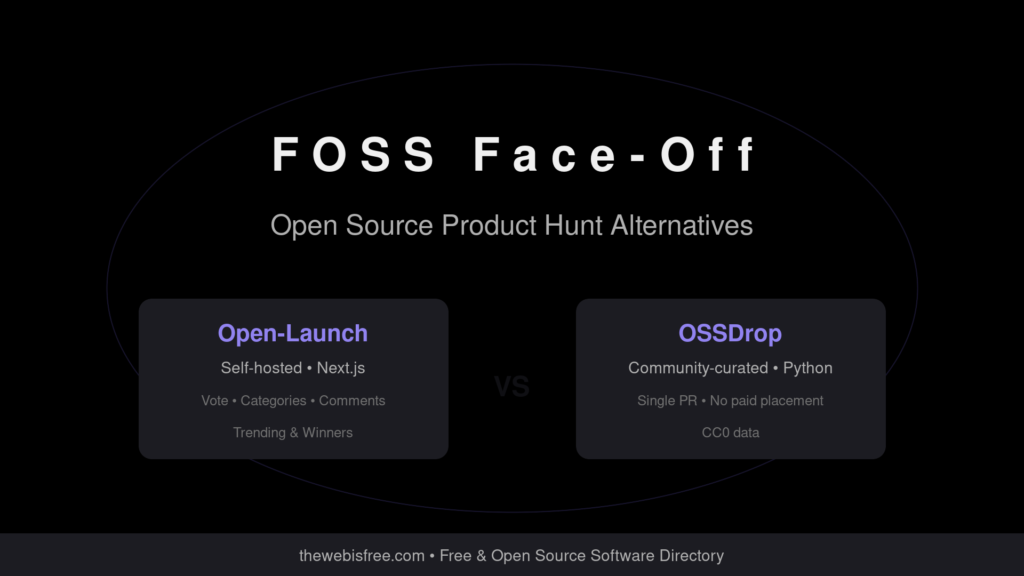
Every indie maker has been there: you pour months into a product, then pin all your hopes on a single 24-hour launch window on a big proprietary platform. The algorithm ignores you, your post sinks, and your launch flops. The community has been grumbling for years — one popular IndieHackers thread asking “I’m building a Product Hunt alternative for indie makers — what would make you actually use it?” drew plenty of interest and even more scepticism. The open source world has answered with its own twist: self-hosted, community-run launchers that put makers back in control. Here I compare two of the most promising — Open-Launch and OSSDrop — so you can decide which deserves your next launch.
1. Open-Launch — Full-Stack Product Hunt Alternative
Open-Launch bills itself as “the first complete open source alternative to Product Hunt.” Built on Next.js 15, React 19 and TypeScript, it is an ambitious, feature-complete launch platform that you self-host and run entirely on your own infrastructure. The project is genuinely active — roughly 327 stars on GitHub, not archived, with commits as recent as March 2026 — so it is a living codebase rather than an abandoned hobby project.
Where Open-Launch shines is breadth. It is not just a voting board; it is a full launch pipeline. Makers can explore the latest launches and trends, collect upvotes on a proper voting system, and browse products by thematic categories. There is a dedicated Trending section and a Winners showcase so the best launches get the spotlight they deserve. Behind the scenes, a personalised dashboard and a full admin panel give both makers and platform operators real control. If you want to build a community around launch day, built-in comments (via Fuma Comment), Discord notifications and solid anti-abuse tooling — rate limiting for comments, votes and the API, plus action cooldowns and anti-spam protection — make it production-ready out of the box.
- Product discovery — explore the latest launches and trends instead of a single firehose.
- Upvote system — a proper voting mechanic drives the Trending and Winners sections.
- Thematic categories — browse launches and products by topic, not just by date.
- Personalised dashboard — track your launches, upvotes and activity in one place.
- Admin panel — full moderation and management when you run your own instance.
- Stripe integration — monetise premium features with built-in payment handling.
- Built-in comments — Fuma Comment gives launch threads real discussion, no external service.
- Anti-abuse hardening — comment/vote/API rate limiting, action cooldowns and anti-spam protection.
- Discord notifications — get pinged the moment your launch gets activity.
The trade-off is a conspicuous one: Open-Launch ships under a custom “Open Launch” licence that GitHub flags as NOASSERTION — meaning it is not an OSI-approved open source licence. That is a genuine caveat. If licence purity matters to you (for resale, redistribution or corporate policy), that non-standard licence is worth reading carefully before you commit.
2. OSSDrop — Community-Curated Directory, Zero Placement Fees
OSSDrop takes a completely different approach. Its tagline is “Drop your open-source tool” — and it is less a self-hosted platform and more a community-curated directory where developers share tools, vote and discuss. Written in Python, it is small and focused: roughly 97 stars, not archived, living at ossdrop.com. If Open-Launch is the full SaaS you run yourself, OSSDrop is the trust-driven lists you contribute to.
The curated directory currently holds around 271 tools, and the barrier to entry is deliberately modest: makers add their project with a single pull request. Every entry must be a public repository with an OSI-approved licence and an honest one-line description — no fluff, no paid slots. Star counts, icons and trending data update automatically from each repo, so the listing reflects reality without manual upkeep. And here is the kicker: no placement is ever paid for. Everything is ranked by merit and community votes, which is exactly the trust model a Product Hunt alternative needs.
- Single-PR submission — add your project with one pull request, no account gymnastics.
- OSI-approved licences only — every entry must be a genuinely open source, public repo.
- Automatic metadata — star counts, icons and trending status sync straight from each repository.
- No paid placement — rankings are driven by merit and community votes, never money.
- CC0-1.0 list data — the directory data itself is released under Creative Commons Zero.
- Community discussion — tools are shared, voted on and discussed by fellow makers on r/OSSDrop.
Because the project is young, there is less out-of-the-box infrastructure than Open-Launch — no Stripe monetisation, no admin panel. But what OSSDrop lacks in features it makes up for in ethos: a genuinely community-run home with transparent curation and a licence-pure data set you can even reuse.
Which One Should You Pick?
Choose Open-Launch if: you want to run your own complete launch platform, the way you would run any self-hosted SaaS. It is the closest thing to a true Product Hunt replacement, with voting, categories, trending, comments and monetisation built in. Just weigh that custom licence before you rely on it.
Choose OSSDrop if: you value community trust and simplicity over infrastructure. If you want your launch seen in a curated, licence-pure directory with zero paid placements and zero setup, OSSDrop is the lightweight, ethos-first choice — and contributing is as easy as opening a pull request.
The Bottom Line
The two projects answer different questions. Open-Launch gives indie makers the means to build their own Product Hunt — full-featured, self-hosted, but with a licence caveat to read. OSSDrop gives the community a fair, transparent and genuinely free place to drop a tool — modest in scope but pure in intent. Whichever fits your launch, the underlying message is the same one that thread sparked: you no longer have to gamble on a single proprietary launch window. There are open source alternatives that put makers first.
Hunting for more free and open source tools to grow with? Browse the full free and open source directory, or if you have built something worth sharing, submit your tool to the community.