Tracecat
- Platform
- Linux Docker
- Licence
- AGPL-3.0 Open source
- Website
- tracecat.com
- Source code
- github.com/TracecatHQ/tracecat
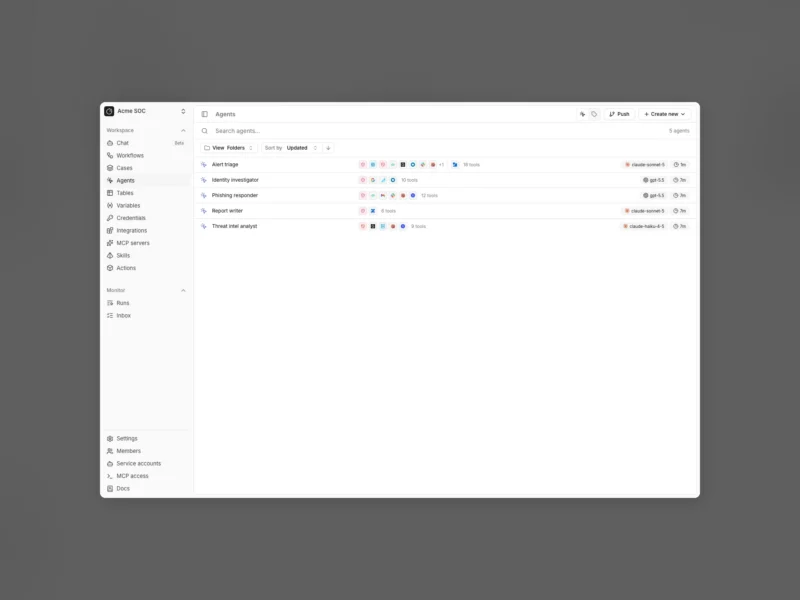
Tracecat is an open-source security automation platform for security teams and the AI agents that work alongside them. It bundles agents, case management, workflows, lookup tables and an MCP layer into one self-hostable platform, so a SOC team can build detection triage, phishing response or threat-intel enrichment as automation instead of a pile of one-off scripts.
Everything is unlimited on the open-source tier: no cap on agents, cases, workflows or lookup tables. You can run it yourself wherever you like — Docker, Kubernetes or AWS Fargate — or use the hosted Tracecat Cloud, and the self-hosted path works fully air-gapped for environments that cannot reach the internet.
Core capabilities
- Agents and skills — build custom agents with prompts, tools, MCP servers, subagents and reusable skills. Agents get their own workspace chat, tool approvals and timeouts.
- Case management — track, automate and resolve incidents with agents doing the first pass, with an inbox for the calls that need a human.
- Workflows — deterministic, durable execution on Temporal, so long-running automations survive restarts and scale horizontally.
- Tables — store and query structured data (watchlists, IOC lists, lookup tables) next to the automation that uses it.
- Tracecat MCP — turn prompts into automations from Claude Code, Codex, Copilot or any other MCP-capable client, and connect your own agents to remote or local MCP servers.
- Integrations — over 100 pre-built connectors plus 50+ Tracecat-hosted MCP servers for common security tooling, with a custom registry that syncs your own Python scripts from a Git repository.
Operational features
- Sandboxed execution — untrusted code and agents run inside
nsjailsandboxes or isolatedpidruntimes. - No SSO tax — SAML and OIDC single sign-on are available without an enterprise upgrade.
- Free audit logs — exportable into your SIEM for a full record of what agents and humans did.
- Variables and credentials — reuse values and secrets safely across workflows and agents.
Open source and enterprise editions
The repository is AGPL-3.0 apart from the code under packages/tracecat-ee and the code that gates enterprise features, which carry a separate paid Enterprise Edition licence. The enterprise tier adds multi-tenant workspaces, fine-grained RBAC/ABAC and OAuth 2.0 scopes for humans and agents, a human-in-the-loop approval inbox shared with Slack and email, workspace version control that syncs workflows, agents and table schemas to GitHub, GitLab or Bitbucket, and metrics for workflows, agents and cases. The whole core platform remains usable and unlimited on the open-source licence.
Who it is for
Security engineers and SOC teams that want SOAR-grade automation without a vendor contract, and that want their agents to act on real cases, workflows and data — under sandboxes, audit logs and human approval — rather than in a chat window beside them.
Licence
Open source — GNU Affero General Public License v3.0 (AGPL-3.0) for the core platform, as stated in the repository and its LICENSE file. The packages/tracecat-ee directory and enterprise-gated code are proprietary.