Reactive Resume
- Platform
- Web Android iOS Docker Linux
- Licence
- MIT Open source
- Website
- rxresu.me
- Source code
- github.com/reactive-resume/reactive-resume
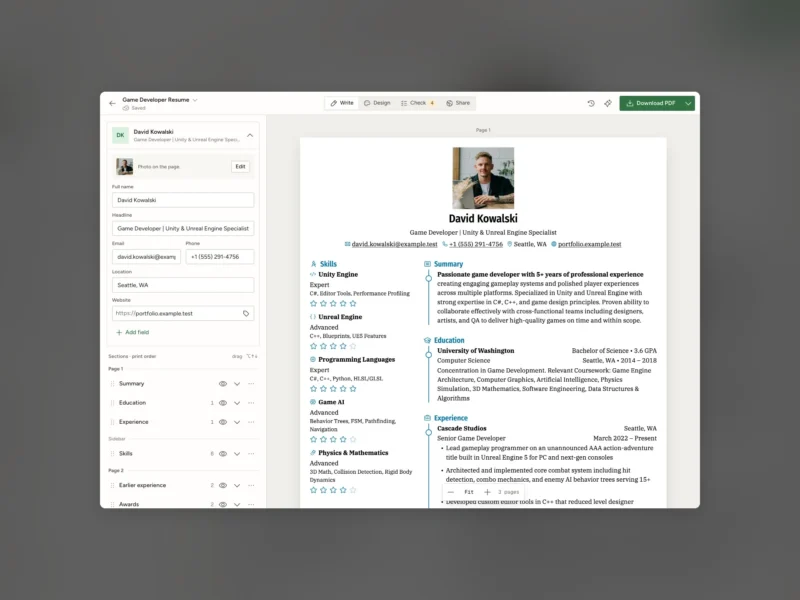
Reactive Resume is an open-source resume and cover-letter builder that runs in the browser and can be self-hosted with Docker. You write into a live document while a PDF preview renders beside it, so the finished page is what you edit rather than a form you fill in and review later. Version 6 widened the project from a resume editor into a small job-search workspace: resume checks and an ATS view, standalone cover letters with version history, and application tracking from first save to signed offer. The code is MIT licensed with no ads, no tracking and no paid tier, and the same application runs on the public instance at rxresu.me or on your own PostgreSQL and storage.
Key Features
- Write, Design and Check editor — inline editing directly on the page with click-to-select, a live PDF preview rendered by Forme in a background worker, autosave, local recovery of unsaved drafts and up to 200 undo steps
- 18 templates — including Porygon and Smeargle, previewed with your own content and filtered by one-column, two-column or ATS-safe; font presets and custom fonts, colours, spacing, A4 or Letter paper and left or right sidebars
- Resume checks — readability findings pinned to the lines they concern, job-posting keyword matching, a view of the plain text hiring software actually reads, checks run on the exported PDF, and a public ATS checker that reads PDFs in the browser without an account
- Cover letters and versions — standalone letters with their own editor and exports, linkable to a resume so sender details and design stay in sync, automatic and named versions to preview and restore, and a trash with a 30-day recovery window
- Job application tracking — List, Board, Insights and Calendar views from Saved to Offer, jobs saved from a URL or a pasted posting, a tailored resume and drafted letter per job, contacts, notes, follow-ups, interview scheduling and CSV import or export
- Import and export — import Reactive Resume JSON, JSON Resume, LinkedIn data exports, PDF and Word files; export PDF, Word (DOCX), Markdown or JSON; share through public links with optional password protection plus view and download statistics
- Self-hosting — the same application deploys on Docker, Kubernetes, Vercel or Cloudflare Workers with PostgreSQL for data and your own storage for uploads; PDF generation uses Forme in the browser and on the server, so no Chromium or external print service is involved
- API and AI options — a REST API and an MCP server for documents, imports, exports, checks and applications, with an optional AI assistant that talks to OpenAI, Anthropic, Google Gemini, OpenRouter, Ollama or another compatible endpoint you supply
Why Use Reactive Resume?
Most resume builders are forms that hand back a template-shaped PDF, and the interesting part of the job — matching a posting, running the same CV past a dozen application systems, keeping a tidy history of who was contacted and when — is left to spreadsheets. Reactive Resume keeps the document and the search in one place: the editor works on the actual page, the checks read the same PDF a recruiter’s software will parse, and the application board remembers which version went where. Because the source is MIT licensed and the whole stack is a Docker deployment, the data stays on your own database instead of someone else’s service, which matters for candidates who would rather not leave a permanent record of every employer they applied to.
Caveats
Word (.docx) import needs a connected AI provider; JSON, JSON Resume, LinkedIn and PDF imports work without one. The AI assistant, the writing review and job-posting keyword search through Firecrawl, Tavily or Exa all rely on a provider you choose, and self-hosters carry the keys and any usage costs. Self-hosting is not a single container: it needs PostgreSQL and storage alongside the application, so budget for a Compose stack or a Kubernetes deployment. The public rxresu.me service is free with no paid tier, but its limits are set by the project rather than by an SLA.
Use Cases
- Job hunting with one canonical CV — a single library of versions, each tailored per posting and tracked through to an outcome
- Career changes and long searches — keyword matching against a posting shows what a CV is missing before it is sent
- Freelancers and contractors — several CV and letter variants for different clients, with public share links instead of attachments
- Privacy-conscious applicants — self-hosted so resumes and application history never leave your own infrastructure
Licence
MIT for the code in the reactive-resume/reactive-resume repository — take it, modify it and run it internally or commercially, keeping the copyright notice. The hosted rxresu.me instance is free, ad-free and without a paid tier; hosting and any connected AI provider are billed to whoever runs them.
Alternatives
- Overleaf — LaTeX editor with a live PDF preview and CV templates, better suited to a typeset academic or technical CV
- Collabora Online — LibreOffice-based collaborative editing in the browser when the CV has to live in .docx beside other office documents
- ONLYOFFICE — a self-hosted office suite with Word, Excel and PowerPoint editing for documents that need real office file formats