PatchPanda
- Platform
- Docker Web Self-hosted Linux
- Licence
- MIT Open source
- Source code
- github.com/dkorecko/PatchPanda
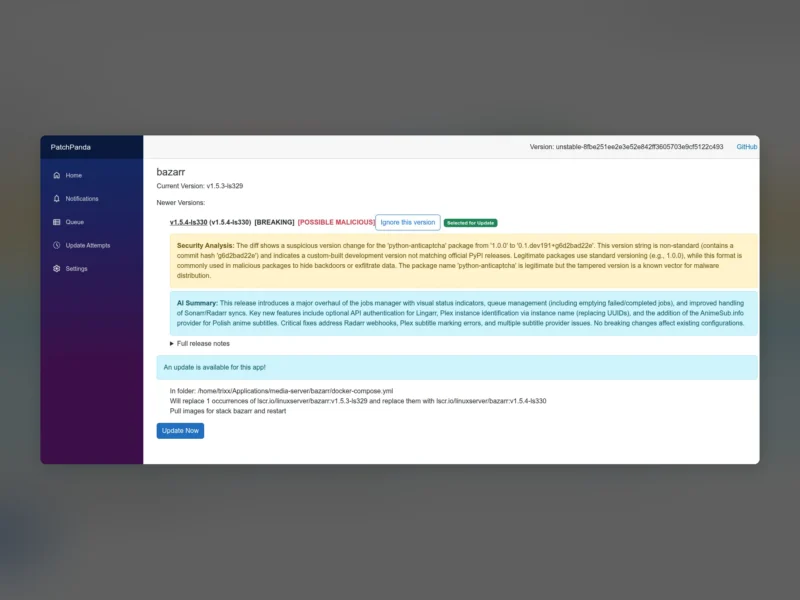
PatchPanda is a self-hostable update manager for Docker Compose stacks: a web UI that inventories your running stacks, works out which image tag every service uses, traces each image back to its GitHub repository and then reports the newer releases with their notes – so an update is something you can read and review rather than a silent pull-and-restart.
It is written in .NET 10 with Blazor Server and ships as a single container. Rather than replacing your deployment manifests, it edits the compose and .env files you already have and then runs the ordinary docker compose pull and docker compose up -d for the target stack. You keep the files, and you can still roll back by hand.
What it does
- Discovers running Compose projects and lists every service with its current image tag.
- Extracts repository information from image labels and OCI annotations, then queries GitHub releases with per-container tag regexes to filter valid version candidates.
- Groups related services into one app (for example
app-webandapp-worker) so a multi-container stack moves as a single unit. - Flags releases marked as breaking changes, and can summarise release notes through Ollama or any compatible LLM API.
- Optional security analysis: the model reviews the git diff between two versions for suspicious code, backdoors or unexpected network calls.
- Update queue with live logs, update-all for several apps at once, and a best-effort revert if an update fails. A history page keeps the stdout and stderr of every attempt.
- Notifications to a Discord webhook or any Apprise URL (email, Telegram and the rest).
- Automatic non-breaking updates after a configurable delay, plus a per-version ignore for releases you do not want to see again.
- Portainer API integration for the stacks it manages, and a manual override when the detected repository is wrong.
- Runs on Linux and Windows hosts.
Why not just Watchtower
Watchtower-style agents watch image tags and restart containers when a new image appears. PatchPanda is release-oriented: it reads GitHub release notes, surfaces pre-releases and breaking-change markers, understands multi-container apps, and shows you an update plan before anything runs. That makes it a fit for hosts where you want to know what changed while still automating the routine pins.
Deployment
The published image is ghcr.io/dkorecko/patchpanda:latest and the web UI listens on port 5091, with a reference compose file in the repository. It needs the Docker socket mounted at /var/run/docker.sock to see your stacks, BASE_URL so notification links point somewhere useful, and GITHUB_USERNAME with GITHUB_PASSWORD (a personal access token) for release lookups. AI summarisation and security scanning are optional: set OLLAMA_URL and OLLAMA_MODEL to enable them. Discord and Apprise notifications are optional as well.
Mounting the Docker socket gives the container control over the host daemon, so treat it as a privileged service and keep it on an internal network.
Beta software. The author ships PatchPanda as-is: keep backups, try it on non-critical stacks first, and expect the interface to change.
Licence
MIT – free and open source; the licence text is in the repository.
Alternatives
- Diun – notification only: tells you a newer image exists and never applies it.
- Portainer – full container management UI with stack updates and recreates.
- Watchtower – the classic automatic pull-and-restart agent, with no release notes and no review step.
- Dockge – Compose stack manager with a compose-file editor; updates stay manual.