osTicket
- Platform
- Linux Windows Docker Self-hosted
- Licence
- GPL-2.0 Open source
- Website
- osticket.com/
- Source code
- github.com/osTicket/osTicket
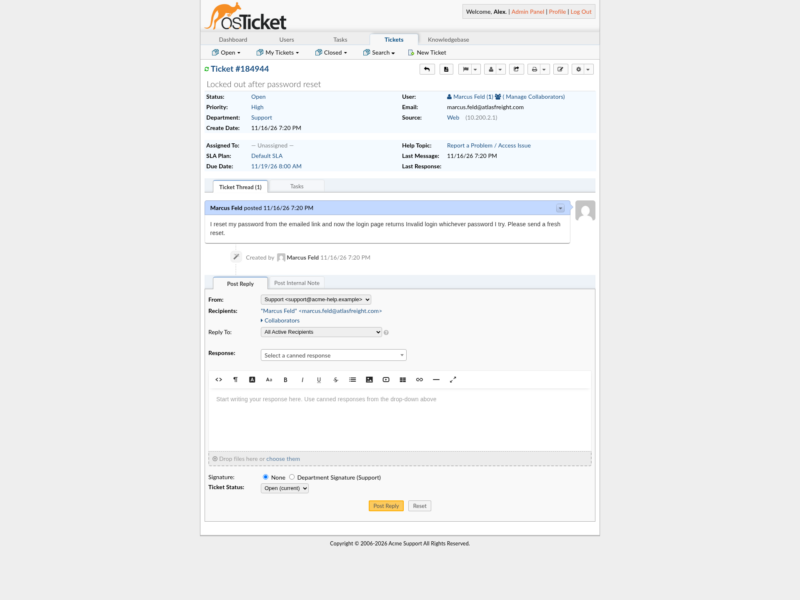
osTicket is a free and open-source support ticketing system written in PHP. Enquiries that arrive from email, a web form or a phone call are turned into tickets, stored in one database and worked from a single multi-user agent panel, so a support team can assign, answer and archive requests without stitching three tools together. It is licensed under the GPL-2.0, the current release is v1.18.4 (June 2026), and it has been in continuous development since 2006 — the project repository alone carries more than 4,000 stars and 1,800 forks.
It is the traditional self-hosted alternative to per-seat SaaS helpdesks: an Apache or IIS server with PHP and MySQL is all it needs, there is no paid tier and no feature held back behind a licence key. The vendor does sell commercial support and a separate cloud-hosted product, but the software you download is the complete system, and every ticket, attachment and customer record stays on a server you control.
Key Features
- Unified ticket queue — email, web form and phone enquiries land in the same list with status, priority, department, SLA and last-updated ordering
- Customer support portal — a branded self-service site where customers open tickets, check status and read the knowledge base without an agent
- Help topics and custom forms — define the topics a customer can choose and attach the specific fields each one needs, so a billing question never arrives without an invoice number
- Ticket filters — route, assign, tag, reject or auto-reply on arrival with rules based on sender, subject, body, help topic or department
- SLA plans — per-department grace periods and schedules that set a due date on every ticket and flag the ones about to breach
- Canned responses and internal notes — reusable replies for the common questions, plus notes the customer never sees, on the same thread
- Departments, assignment and transfer — work is split across teams, transferred between departments and assigned to individual agents with collaborators on the CC list
- Knowledgebase — internal and public FAQ articles that agents can insert into a reply
- Dashboard and reports — ticket volume, response and resolution statistics by department and agent, plus CSV export of any queue
- Extensible — an HTTP API for creating and reading tickets, plugins for extra channels and integrations, and language packs for the staff and client interfaces
Deployment and Requirements
- An HTTP server running Apache or Microsoft IIS
- PHP 8.2 to 8.4, with 8.4 recommended, and the mysqli extension
- MySQL 5.5 or newer (MariaDB works)
- ctype, fileinfo, gd, gettext, iconv, imap, intl, json, mbstring, phar, xml, xml-dom and zip are recommended; APCu improves performance
- Installation is a two-step process: clone the repository, run php manage.php deploy –setup into your web root, then complete the browser-based setup and remove the setup/ directory
- There is no official Docker image — community images exist, and the maintainers support the git-deploy path
Why Use osTicket?
The case for osTicket is ownership and cost. A support desk is where customers’ problems and personal data accumulate, and running it yourself keeps both on infrastructure you control with no per-agent bill. Setup is genuinely small — a web server, PHP and MySQL, all of which most organisations already have — and the vendor also publishes security patch releases, as it did for the June 2026 round of fixes.
Worth knowing before you commit: the interface is a traditional server-rendered PHP application and looks dated next to newer helpdesks, live chat and telephony are not part of the core product, and heavier customisation means writing plugins against the PHP codebase rather than configuring a modern API.
Use Cases
- IT and internal service desks that need a ticket queue, SLAs and assignment without a per-seat subscription
- Small businesses replacing a hosted helpdesk where the monthly bill scales with agent count
- Organisations with data-residency or procurement rules that require customer records to stay on their own servers
- Teams that already run a LAMP stack and want a ticketing system that deploys into it in an afternoon
Alternatives
- Zammad — a modern open-source helpdesk covering email, chat, telephony and social channels, with a far more current interface; the better pick when channels and UX matter more than a minimal footprint.
- Libredesk — a young Go-based shared inbox with a chat widget, help centre and AI features, for teams that want something fresh rather than a long-established codebase.
- FreeScout — a deliberately lightweight PHP shared inbox that stays close to email, when you want the smallest possible moving parts.
- OTOBO — a full service-management platform with ITSM processes, for workflow and process compliance rather than simple ticketing.
- Request Tracker — the long-standing Perl-based system built for complex workflows and heavy customisation.
- Bugzilla — if what you actually need is defect tracking rather than customer support.