OneUptime
- Platform
- Web Linux Docker
- Licence
- Apache-2.0 (core); ee/ directories under the OneUptime Enterprise License Open source
- Website
- oneuptime.com
- Source code
- github.com/OneUptime/oneuptime
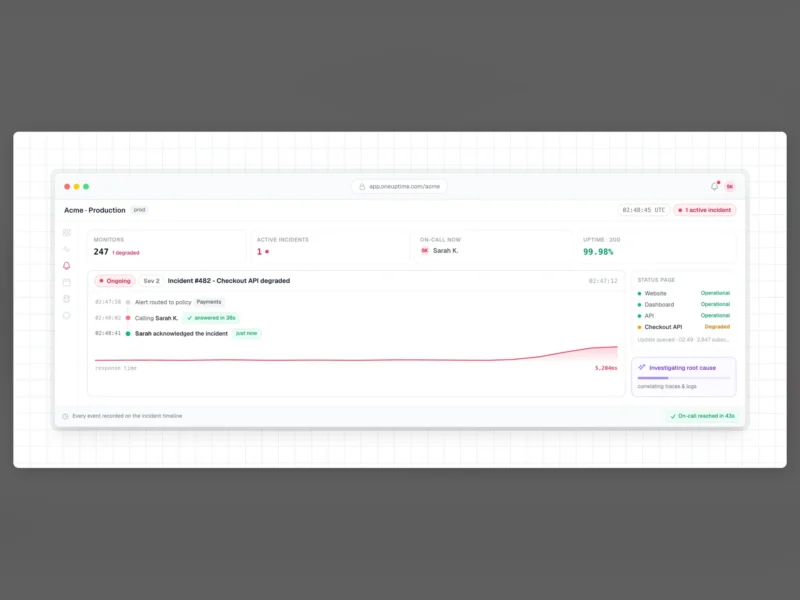
OneUptime is an open-source observability and incident-management platform. It checks that your websites, APIs and servers work, collects the logs, metrics and traces your applications send, pages whoever is on call when something breaks, and keeps customers informed on a status page — so the tool that notices a problem is the one that pages your team.
What it covers
- Monitoring — uptime checks for websites, APIs, ports, DNS records and certificates from probes around the world or from inside your own network, plus server, Kubernetes, Docker, VMware, database and network-device monitoring.
- Incidents and on-call — every incident runs on a single timeline; alerts are delivered by phone, SMS, email, push, Slack or Microsoft Teams, with escalation policies until someone responds.
- Status pages — public or private status pages, including scheduled-maintenance announcements.
- Logs, metrics and traces — ingested with OpenTelemetry, searchable, with dashboards; exceptions, profiles, real user monitoring and security events live in the same product.
- Workflows and runbooks — automate routine response work and connect ticketing tools such as Jira and ServiceNow.
- AI SRE — investigates new incidents, posts a root-cause analysis with citations, and can open a pull request with a proposed fix for review.
- API, CLI and Terraform — manage monitors, status pages and on-call schedules as code, plus an MCP server for MCP-capable assistants.
Running it yourself
OneUptime can be used as a managed cloud service or self-hosted. The self-hosted route is a Docker Compose stack on a Linux server: you need at least 8 GB of memory, Docker, Docker Compose, Git and Node.js, and you point the HOST variable in config.env at the domain or IP address people will use to reach the instance. A release branch is published for deployments, and Kubernetes/Helm setups are documented separately.
The project is open core: everything outside the ee/ directories is Apache-2.0, while the enterprise-only features in those directories fall under the OneUptime Enterprise License — check which parts you need before planning a self-hosted rollout.
Alternatives
- Grafana — dashboards and visualisation over Prometheus, Loki and other data sources.
- Prometheus — metrics collection, alerting rules and a time-series database.
- Uptime Kuma — a lightweight self-hosted uptime monitor with status pages.
- Netdata — real-time server and container performance monitoring.
- Zabbix — enterprise-grade infrastructure monitoring with agent-based checks.
Compare OneUptime with the rest of the directory on the all tools page, or submit a tool that is missing.