Mitra
- Platform
- Linux Docker Self-hosted
- Licence
- AGPL-3.0 Open source
Overview
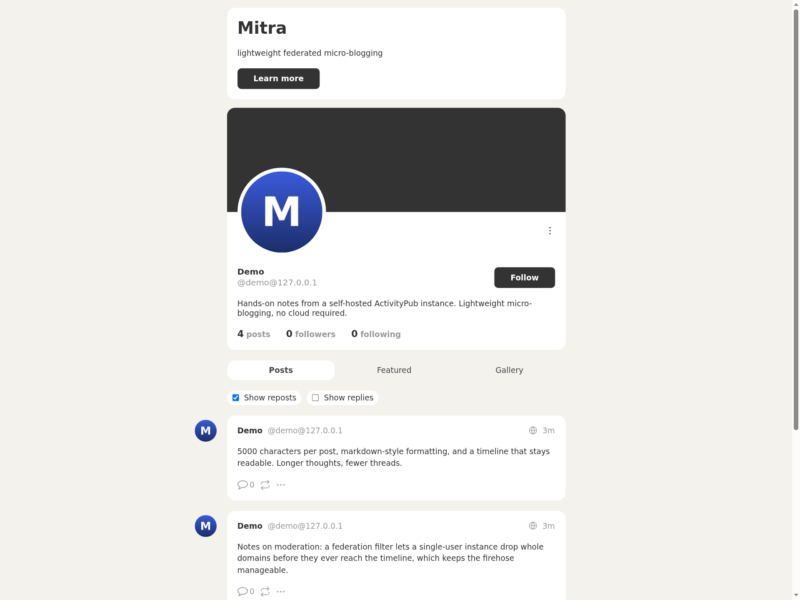
Mitra is a self-hosted micro-blogging server that speaks ActivityPub, so an instance can follow and be followed by Mastodon, Misskey, Pleroma and the wider Fediverse. It is written in Rust, ships as a single server binary backed by PostgreSQL, and runs comfortably in under 50 MB of memory — small enough for a personal instance on the cheapest VPS you can find. Posts carry quote posts, custom emojis, reactions and polls, and the default character limit is 5000, with markdown-style formatting for longer writing.
Key Features
- Small footprint: a single Rust binary plus PostgreSQL, using well under 50 MB of RAM for a typical single-user instance
- ActivityPub federation: interoperates with Mastodon, Pleroma, Misskey and other Fediverse software, including content from federated blogs and forums
- Mastodon API: existing clients work unchanged — Fedilab and Husky on Android, Tuba on desktop, toot on the command line
- Rich posts: quote posts, custom emojis, reactions, polls, 5000-character default limit and markdown-style formatting
- Groups: run discussions on the instance instead of a single flat public timeline
- Content subscriptions: publish posts that only paying subscribers can read, with Monero as a supported payment method
- Account portability: accounts can be migrated between servers, and the identity can be detached from the server entirely
- Federation over Tor and I2P: reachable where clearnet exposure is not wanted
- Moderation controls: federation filter rules drop whole domains before their posts reach the local timeline
Why Use It
A full Mastodon deployment means Sidekiq, Redis, streaming and web processes before anyone has posted a single word. Mitra collapses that into one binary and one database, which makes a single-person Fediverse presence practical: the server is cheap to run, quick to update, and the whole stack fits in a container image. Because it implements the Mastodon API, you are not locked into its own web client — phones and desktops can use mature Fediverse apps on day one, with the bundled mitra-web frontend and alternatives such as Phanpy, Bloat and Nicolium covering the browser.
Use Cases
- A personal micro-blog on your own domain, federated with the rest of the Fediverse
- A small community or group instance without the operational weight of Mastodon
- Private or paid subscriber content, published from the same account as public posts
- An experimental node for ActivityPub development, or a presence reachable over Tor or I2P
Requirements and Installation
Mitra needs PostgreSQL 15+ and, when compiling from source, Rust 1.85 or newer. Prebuilt mitra_x.y.z_amd64.deb packages are published on the project’s releases page and install with dpkg -i, with Alpine, Nix and YunoHost packages plus community-maintained Docker images available as alternatives. The server listens on plain HTTP and expects a reverse proxy to terminate TLS; Nginx, Caddy and systemd examples ship in the repository’s contrib directory. The default web client (mitra-web) is a separate package and can be served from the same host.