Kitsu
- Platform
- Docker Linux Web Self-hosted
- Licence
- Apache-2.0 Open source
- Website
- kitsu.app
- Source code
- github.com/hummingbird-me/kitsu-tools
Overview
Kitsu is a discovery and tracking platform for anime and manga fans: a catalogue of titles and episodes with a personal library on top, built for logging what you are watching or reading, scoring it, and sharing it with other people. The reference instance runs as a free hosted service at kitsu.app, and the whole stack behind it is open source under the Apache License 2.0 – a Rails and PostgreSQL API server, an Ember web client and a React Native mobile app.
What it deliberately is not is a media server. Kitsu stores metadata and your own progress, never the video or the scanned pages: no streaming, no downloads, no library folders to point at. It is also not self-hosting-first – the project builds for its own hosted instance, and running your own copy means assembling the pieces from source rather than pulling one image. What you get in exchange is a curated, community-maintained database and a social layer (groups, posts, reviews) that a plain spreadsheet cannot match.
Key Features
- Separate anime and manga libraries: each title is tracked as an anime entry or a manga entry, with its own episode or chapter counters.
- Progress tracking down to the episode: mark whole seasons or step through single episodes and chapters as you go.
- Statuses and ratings: keep the library organised by viewing status and score titles you have finished.
- Reviews and posts: write long-form reviews, or short posts that appear in a feed alongside other users.
- Groups: communities with their own membership, posts and discussions, reachable from the main navigation.
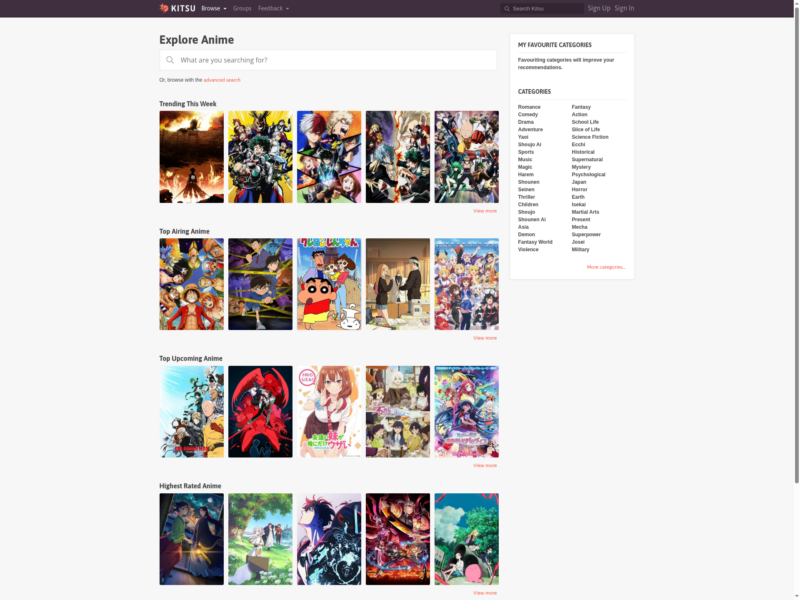
- Discovery: trending, top airing, upcoming and highest rated lists, plus genre and category browsing and an advanced search with filters.
- Public API: a documented JSON:API endpoint (
kitsu.app/api/edge) used by the first-party web and mobile clients, so scripts and third-party apps can read and update libraries. - Official mobile apps: the React Native client ships for iOS and Android from the same repositories.
- Imports and exports: moves an existing list in from other tracking services and keeps a copy you can take elsewhere.
Why Use Kitsu
The hosted site is the shortest path: create an account and the catalogue, the progress tracking and the community are there without running anything. The reason to care that it is open source is different – the data model and the API are public, so a library is portable and the client can be extended or replaced. If the point is to own the whole thing, Kitsu is a project you build and operate rather than install; if the point is a well-maintained anime and manga database with a social side and no lock-in, the hosted service plus the API is the practical choice.
Typical Uses
- Replacing a notes file or a streaming site’s “continue watching” shelf with one cross-service watchlist.
- Keeping a manga reading list next to an anime watchlist instead of in two apps.
- Following seasonal line-ups through the trending and top-airing lists.
- Writing reviews and posting them to a community that actually reads them.
- Pulling a library into a dashboard or script through the public API.
Self-Hosting and Requirements
Self-hosting is a source build, not a one-line deploy. The meta repository hummingbird-me/kitsu-tools holds the development environment and tooling; the pieces it wires together are kitsu-server (Rails API on PostgreSQL with Redis), kitsu-web (an Ember client that has to be built and served as static assets) and kitsu-mobile for the apps. Expect to configure the client against your own API host, and to look after the database and Redis yourself. The upstream project runs its own instance at kitsu.app, so treat the self-hosted path as a supported build target rather than a turnkey product.
Licence
Open source. Apache License 2.0 across the platform repositories (kitsu-tools, kitsu-server, kitsu-web, kitsu-mobile), which permits commercial use, modification and redistribution provided the notices are kept. The hosted service at kitsu.app is free to use and separate from the licence on the code.