HomeButler
- Platform
- Linux macOS Windows Docker Self-hosted
- Licence
- MIT Open source
- Website
- homebutler.dev/
- Source code
- github.com/Higangssh/homebutler
HomeButler
Website: homebutler.dev
HomeButler is a single Go binary that keeps a snapshot of a home server and, on the next run, reports only what changed: a container that vanished, a new one that appeared, a port now answered by a different process, a disk that moved. Most homelab dashboards show the current state and leave the judgement to us; six containers before and six after is not “no change” when one of them is a different container. HomeButler exists for that gap. It needs no daemon and no database, and nothing runs on the machines it watches between runs — the binary is put there once and called over SSH.
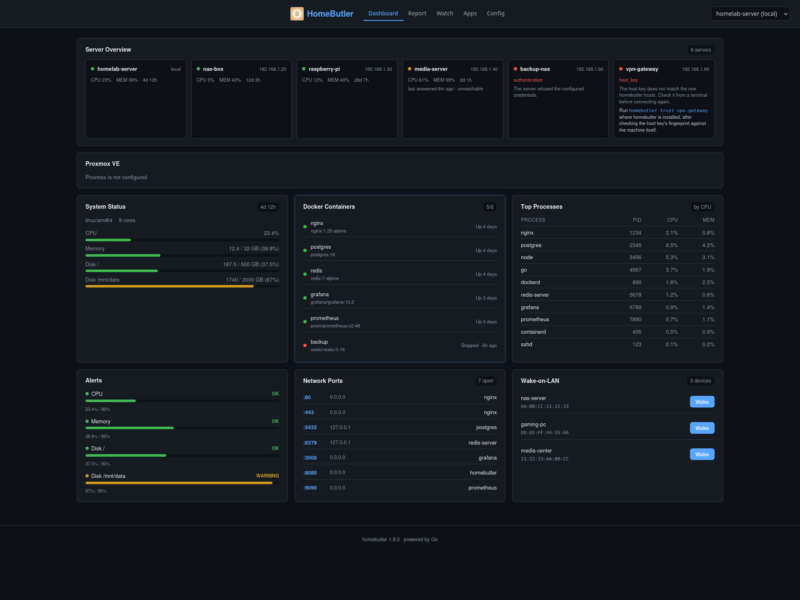
It sits beside the tools already in a homelab rather than replacing them. Uptime Kuma answers “is it up”, Netdata or Beszel draws the graph, Dozzle shows the logs; HomeButler answers what is different since last time and whether it matters. Every change line names the kind of change, the thing it happened to and what happened, and the same words appear in the JSON output, so cron jobs and agents can branch on them without parsing prose. Run homebutler serve --demo to see the dashboard filled with sample servers.
Key Features
- Change-aware reports: compares against the last snapshot and flags gone, new, replaced, image, state, port, disk and skipped. The replaced kind catches a container recreated under the same name, which a count-based check would miss.
- Honest all-clears: when a comparison cannot be made — Docker was down when either snapshot was taken — the report says skipped rather than implying nothing changed.
- Inventory and topology:
inventory scanmaps containers, app ports and system ports, links Docker-published ports back to their container, and exports a Mermaid diagram for docs or an agent. - Doctor preflight: a read-only check for disk pressure, stopped containers, public ports, stale backups and missing report baselines, naming the next command for each finding;
--strictmakes it usable from cron. - Backup drills: boots the latest backup as a second copy in an isolated Docker network and port, requires an HTTP health check, then removes what it made. A failed drill exits non-zero.
- Restart watch: monitors Docker, systemd and PM2 targets, saves logs from before and after a restart, classifies the crash from exit codes and log patterns, and detects flapping loops.
- App install: deploys any of fifteen self-hosted apps through an editable docker compose file, with port, DNS and Docker-socket pre-checks; uninstall keeps data, purge removes it.
- MCP and dashboards: an embedded web dashboard and a Bubble Tea TUI sit alongside a built-in MCP server whose tools are classed read, write or destructive, so an agent gets structure instead of an SSH shell.
Licence
MIT. That is an OSI-approved permissive licence: use, modify and redistribute the code, including commercially, as long as the copyright notice is kept. The project states there is no account, no paid tier and no AI service required — the judgement rules are written down and the same input produces the same report.