Fireshare
- Platform
- Web Docker Linux
- Licence
- GPL-3.0 Open source
- Source code
- github.com/fireshare-app/fireshare
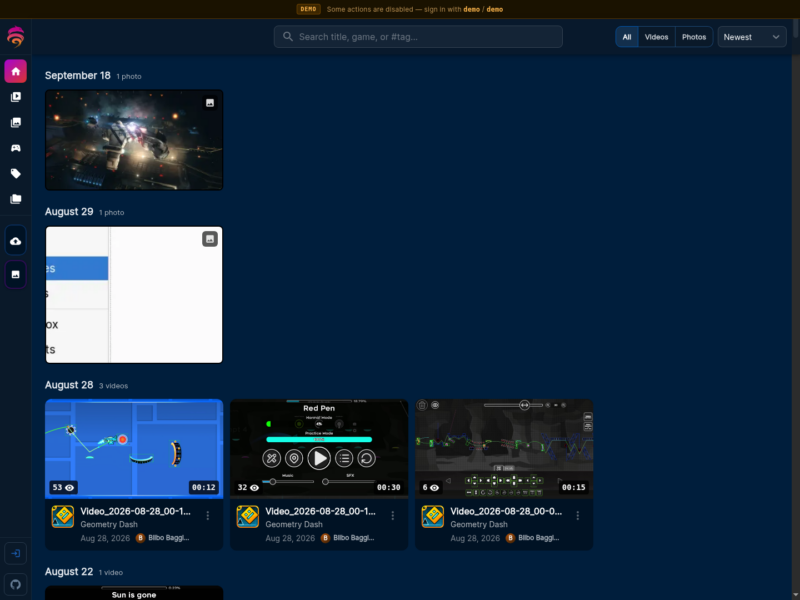
Fireshare is a self-hosted way to share game clips and other video with a small group of people over unique links, without uploading anybody’s footage to a video platform. It runs from a Docker container, scans the folders you point it at, and builds a browsable feed out of whatever is in them: videos, photos, posters and metadata. The goal is closer to a private media library than to a social network, with the sharing controls of the latter.
Links instead of uploads
Every clip gets its own page with a short, unguessable URL, and that page can be public or private: a private video is reachable only by whoever holds the link, and can be locked with a password on top. Videos can be grouped into folders that are shared the same way, so a whole session of recordings travels as one link. Open Graph metadata is generated per link, so a clip pasted into a chat shows a real thumbnail and title instead of a bare URL, and an RSS feed exposes everything that is public for people who prefer to subscribe.
Organised around games
- Clips are filed under the game they belong to, with cover art pulled in automatically and the option to add a game by hand with your own artwork.
- Tags and search make a growing library navigable, and view counts show which clips people actually watch.
- Video cropping is available in the interface, so a capture with unwanted borders can be trimmed without re-recording it.
- Photos sit alongside the videos in the same feed, which is convenient for screenshots taken in the same session.
Transcoding when the source is awkward
The original file is always served to the viewer untouched. Transcoding is optional and, when enabled, spends CPU or a GPU on producing additional lower-quality versions for adaptive streaming rather than altering the original, which also means HDR captures can be tone-mapped to SDR so they do not arrive washed out. MP4, M4V, MOV and WebM containers are supported, carrying H.264, H.265, AV1 or VP9 video; because the source file is what gets served, anything outside those formats has to be converted before it goes in.
Users, uploads and security
An instance can serve several people with per-user permissions, and each account can have a shareable profile page listing what that person uploaded. Uploading is optional and can be switched off entirely, or opened up for scripts and other tools through upload tokens. Security options go further than most hobby projects bother with: TOTP two-factor authentication, an IP whitelist for logins, and Discord or webhook notifications when something new arrives.
Deployment
The project is Docker-first: the container takes four volume mounts, one for the internal database, one for generated posters and metadata, and one each for the source video and image directories, so the media itself stays in ordinary folders that other tools can read. Configuration is environment variables — the admin username and password, the public domain used for link previews, and whether transcoding is on. The lighter latest-lite image omits the transcoding toolchain for hardware that will not use it. Fireshare is published under the GPLv3 and developed in the open, with a hosted demo available for a look before installing.