DRL (D, the Roguelike)
Overview
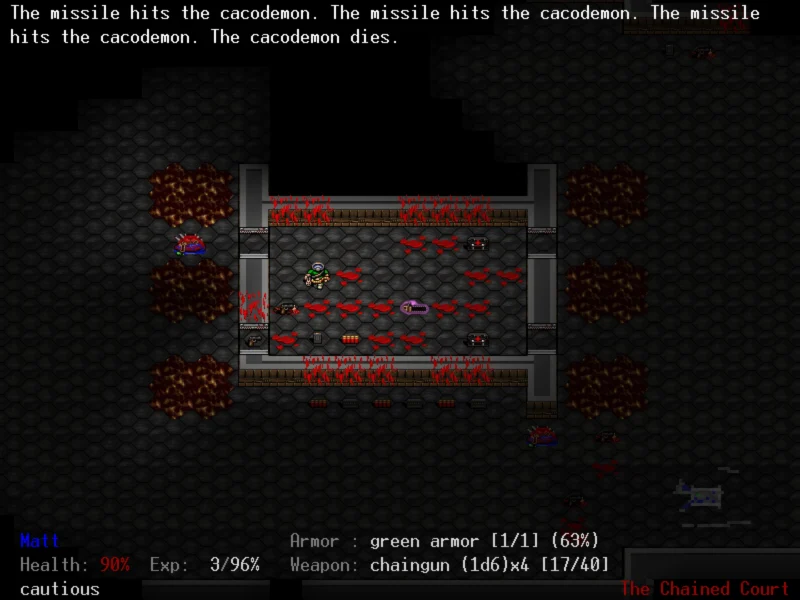
DRL — originally DoomRL (“Doom, the Roguelike”) and now officially D, the Roguelike — is a fast “coffee-break” roguelike from ChaosForge that reimagines the 1990s FPS Doom as a turn-based, tile-based dungeon crawl. You fight your way through 25 mostly randomly generated levels of Phobos and Deimos with the classic Doom arsenal, and the design is deliberately tight: most runs are short enough to finish in a single sitting. Development began in 2002, the source was later released, and in August 2025 the game reached version 0.10 alongside the commercial remake Jupiter Hell Classic, which funds continued work on the open-source original.
Key Features
- 25 levels of mostly random Doom dungeons, plus numerous hand-built special levels.
- Arsenal of classic Doom weaponry — pistol, shotguns, chaingun, rocket launcher, plasma rifle and BFG — with an assembly system for building upgraded variants.
- Wide range of assembly, unique and exotic items, consumables and armour.
- Trait-based level-up system with three classes (Marine, Technician and Scout), each with its own perks and Master Traits.
- Almost all the Doom monsters, from former humans and imps up to the Cyberdemon and Spider Mastermind.
- Text-based gore system and a detailed death and score screen.
- Medals and badges for excellence and advancement, plus a system for charting player progress.
- Original Doom sound effects and music, with an optional high-quality audio pack.
- Modding system with multi-level modding and score/player-data support.
- Comfort features added in 0.10: diagonal movement, corner-shooting, shotgun-scouting, weapon unloading, save-and-quit at any point, new visual effects, an enrage mechanic and infighting/Nightmare variants.
Why Use It
DRL is one of the most approachable traditional roguelikes. It plays fast, the goal is always clear, and its Doom theme means every monster and pickup has an immediately readable purpose — so you spend your time making decisions rather than memorising a manual. At the same time the trait trees, weapon assemblies and difficulty levels (up to Nightmare) give it genuine depth, and short runs make it easy to learn by playing. Being open source, it is also a well-preserved example of a long-lived FreePascal/SDL game codebase.
Use Cases
- Quick single-session roguelike runs when you only have twenty minutes.
- A friendly entry point into traditional turn-based roguelikes for players arriving from action games.
- Score-chasing and speed-running, tracked with medals and badges.
- Trying community mods through the built-in modding system.
- Studying a mature FreePascal game engine that has been maintained since 2002.
Platforms
Windows (installer, full and low-quality portable ZIPs) and Linux (full and low-quality tarballs). On Linux you need libsdl2, libsdl2-image, libsdl2-mixer and libsdl2-ttf installed, plus smpeg if you want to use the high-quality audio. There is no official macOS binary yet — the developers suggest compiling it yourself with Lazarus/FreePascal. DRL keeps its data and save files in the directory the binary runs from, so launch it from its own folder.
Licence
Open source — GPL-2.0. The source code is released under the GNU General Public License v2, and the game itself is free to download and play on every platform. Development is supported by sales of the commercial remake Jupiter Hell Classic.
Website
https://drl.chaosforge.org/ — official site with downloads, screenshots and the full changelog. Source code: github.com/chaosforgeorg/drl.
Similar Tools
- Dungeon Crawl Stone Soup — another classic, actively developed dungeon-crawl roguelike.
- Brogue — tightly designed turn-based roguelike with a very readable interface.
- NetHack — the genre-defining deep, item-rich roguelike.