Bubblewrap
Overview
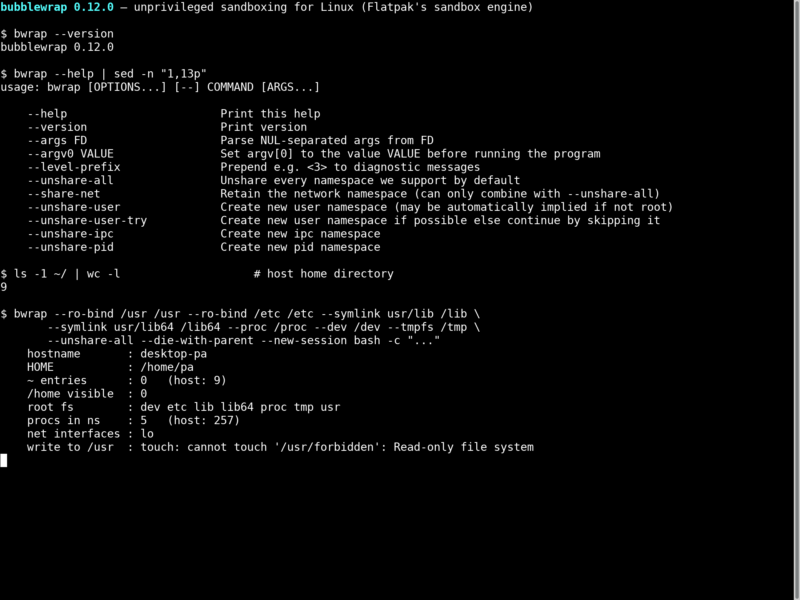
Bubblewrap (bwrap) is the low-level sandboxing tool that lets an unprivileged user run a program inside a locked-down view of the filesystem. It creates a brand-new mount namespace whose root is an empty tmpfs invisible from the host, and then hands you a small set of options — --bind, --ro-bind, --tmpfs, --dir, --symlink, --proc, --dev — with which you assemble exactly the parts of the system the sandboxed process is allowed to see. Anything you do not bind simply does not exist inside: no /home, no /etc/shadow, no host PIDs, no network unless you keep it.
It is deliberately not a complete sandbox with a fixed policy. Bubblewrap is the mechanism; whatever constructs the command line — Flatpak, rpm-ostree unprivileged, libgnome-desktop, sandwine or your own shell script — is the thing that defines the security model. That split is why the code is small and auditable: a single C program of a few thousand lines, built with meson, developed by Alexander Larsson and now maintained by Simon McVittie and contributors in the containers/bubblewrap repository at github.com/containers/bubblewrap (C, LGPL, actively maintained — 0.13.1 landed on 14 October 2026). It is the sandbox engine underneath millions of Flatpak installs, and it is packaged in every major distribution as bubblewrap.
Key Features
- Unprivileged by design — it relies on Linux user namespaces rather than setuid, so any ordinary user can create a sandbox with no help from the administrator. The historical setuid fallback for kernels without unprivileged user namespaces has been removed; upstream now requires working user namespaces.
- Construct-your-own root filesystem —
--ro-bind /usr /usrshares a read-only copy of the host tree,--bindshares it writably,--tmpfs /tmpgives a private temporary directory,--dirand--symlinksynthesise the layout a dynamically linked binary expects. Injections are mountednodevby default. - Namespace isolation you can dial in — the mount namespace is always created; PID, IPC, UTS, cgroup, network and user namespaces are opt-in, or all at once with
--unshare-all(plus--share-netwhen the sandbox still needs the network). A sandboxed--unshare-allrun sees onlyloand a handful of processes, not the host’s 250+. - No privilege escalation inside — bubblewrap sets
PR_SET_NO_NEW_PRIVS, which disables setuid binaries (the traditional escape from a chroot) and makes seccomp filters usable by an unprivileged process. - A real PID 1 — with
--unshare-pidbubblewrap runs a trivial init inside the sandbox to reap orphaned children, sidestepping the classic “PID 1 zombie reaping” problem;--as-pid-1hands that role to your own command. - Seccomp and session hardening —
--seccomp FDloads a BPF filter to restrict which syscalls the sandbox may make, while--new-sessionprotects against terminal-injection (TIOCSTI, CVE-2017-5226) and--die-with-parentguarantees the sandbox dies with its parent. - Honest about its limits — the README states plainly that protection depends entirely on the arguments passed and documents the sharp edges: bound D-Bus sockets can be abused without
xdg-dbus-proxyfiltering, and seccomp restrictions can conflict with browsers that apply their own filters.
Why Use It
The usual alternatives require trust in a setuid root binary, and that is a large amount of privilege to hand to a sandbox front-end. Bubblewrap takes the opposite approach: a small program, no setuid, kernel user namespaces doing the isolation, and privilege escalation inside the sandbox switched off with NO_NEW_PRIVS. The result is a component that is tractable to audit and easy to reason about. It is also composable rather than opinionated — because the caller chooses the mounts, the same binary serves wildly different jobs, from “strong security boundary around an untrusted app” to “run this build with a different filesystem layout”, without either case inheriting policy it did not ask for. And the ecosystem argument is the strongest one at scale: Flatpak, rpm-ostree and desktop portals already build on it, so sandbox behaviour is consistent and battle-tested rather than bespoke.
Use Cases
- Wrapping untrusted software — run a downloaded binary or a friend’s build with a read-only system and no access to your home directory.
- Flatpak and desktop app sandboxing — bubblewrap is the mechanism Flatpak uses to implement each application’s declared filesystem and device permissions.
- Build and test isolation — compile against pinned toolchains with a private
/tmp, no network and a filesystem that cannot be scribbled on outside a chosen work directory. - Running old or exotic toolchains — bind a chroot-style rootfs or a container image’s filesystem and execute inside it as an ordinary user, with no daemon and no root.
- Hardening scripting and automation — a live-upgrade or CI script can wrap a risky step in
bwrap --unshare-all --die-with-parentso a failure cannot reach outside the sandbox. - Security research and testing — reproduce what a process can and cannot see under a given policy before shipping it as a real application manifest.
Platforms
Linux only — it depends on mount, PID, IPC, UTS, network and user namespaces plus seccomp, all kernel features. A modern kernel with unprivileged user namespaces enabled is required (the setuid fallback is gone). It has no daemon, no GUI and no runtime dependencies beyond libc and libcap; it builds from source with meson (meson setup _builddir && meson compile -C _builddir) and is packaged for Debian and Ubuntu (bubblewrap, 0.12.0 in Debian 13), Fedora/RHEL, Arch, Alpine and openSUSE. On distributions that restrict unprivileged user namespaces through AppArmor or a sysctl, the sandbox will need that restriction relaxed — which is exactly why Flatpak’s own 0.12+ builds may request the bwrap capability profile.
Licence and Website
Free and open source. Bubblewrap is released under the GNU Lesser General Public License, version 2.1 or later — the repository’s COPYING file carries the LGPL 2.1 text and the source files declare SPDX-License-Identifier: LGPL-2.0-or-later; Debian’s packaging records the licence as LGPL-2.1+. Source, releases and the issue tracker are at github.com/containers/bubblewrap; the Linux man page (man bwrap) ships with the package and documents every option.
Alternatives
- AppArmor — path-based mandatory access control enforced by the kernel per application profile
- Falco — runtime threat detection over syscall and Kubernetes audit streams
- auditd — kernel-level auditing of syscalls, file access and privileged activity
- Browse more security and privacy tooling in the directory