Checkmk
- Platform
- Linux Windows
- Licence
- GPL-2.0 Open source
- Website
- checkmk.com
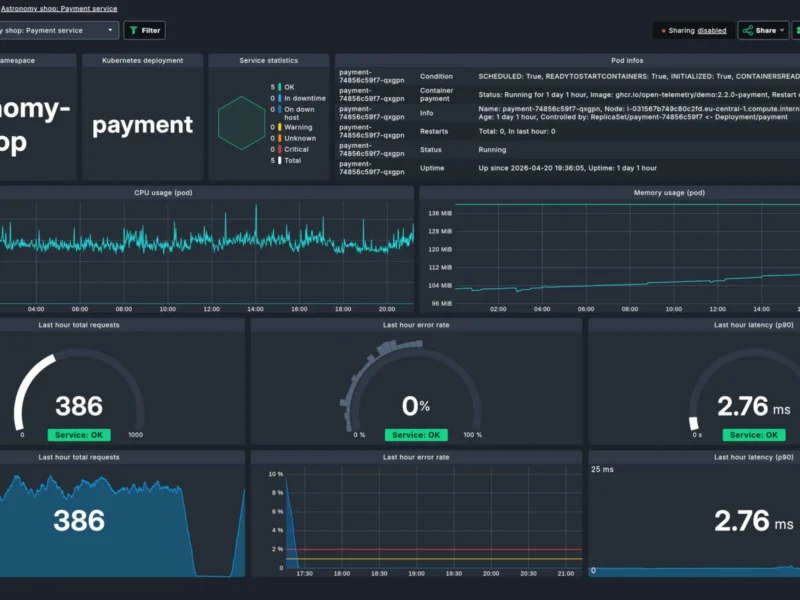
Checkmk is a comprehensive open-source IT infrastructure monitoring system that bridges the gap between legacy on-premises environments and modern cloud-native architectures. Developed in Python and C++, Checkmk originated as an extension to Nagios and has grown into a full-featured monitoring platform with automated discovery, intelligent alerting, and a unified observability approach for cloud, on-premises, and containerised workloads.
Key Features
- Automated discovery — Automatically detects hosts and services across your entire infrastructure, including servers, networks, cloud instances, and container environments
- Intelligent alerting — Advanced correlation and deduplication engine reduces alert noise with smart notification rules, escalation hierarchies, and maintenance windows
- Unified monitoring — Single platform for legacy systems, cloud services (AWS, Azure, GCP), Kubernetes clusters, and containerised applications
- Built-in dashboard builder — Create custom dashboards with drag-and-drop visualisation, graphs, maps, and service overviews for different teams and stakeholders
- Agent-based and agentless — Lightweight agents for Linux, Windows, and Unix systems, plus SNMP, IPMI, HTTP, and REST API checks without agents
- Configuration management — Rule-based configuration with WATO (Web Administration Tool) for efficient management at scale without manually editing config files
- Business view — Map technical monitoring data to business services for executive-level reporting and SLA compliance tracking
Why Use Checkmk?
Checkmk excels at bridging traditional monitoring and modern observability. Its automated discovery dramatically reduces setup time, while the rule-based configuration system makes ongoing management efficient even at large scales. The Raw Edition is fully open-source (GPLv2), with commercial Enterprise, Cloud, and MSP editions adding advanced features like dashboards, reporting, and distributed monitoring. The unified approach means you use one tool for everything from bare-metal servers to Kubernetes.
Use Cases
- Hybrid IT environments with a mix of on-premises and cloud infrastructure
- Kubernetes and container monitoring alongside traditional server monitoring
- Large-scale deployments needing automated discovery and rule-based configuration
- Managed service providers (MSPs) monitoring multiple customer environments
Licence
GNU General Public License v2.0 (Raw Edition)