LinuxGSM
- Platform
- Linux Docker Self-hosted
- Licence
- MIT Open source
- Website
- linuxgsm.com/
- Source code
- github.com/GameServerManagers/LinuxGSM
LinuxGSM
Website: linuxgsm.com
LinuxGSM is a free, open-source command-line tool for installing and running dedicated game servers on Linux. You pick a game from its catalogue and run the installer; it creates the server directory, installs or advises on the dependencies, downloads the files, loads a configuration and applies the fixes needed to get the server running. It covers 148 game servers, from SteamCMD titles (Valve’s command-line server downloader) such as Counter-Strike 2, Garry’s Mod and Rust to Minecraft, TeamSpeak 3 and Factorio. The project also supports Docker, where a server can be started with one command. We would reach for it when a game server should be managed from a terminal and a cron job, not from a control panel.
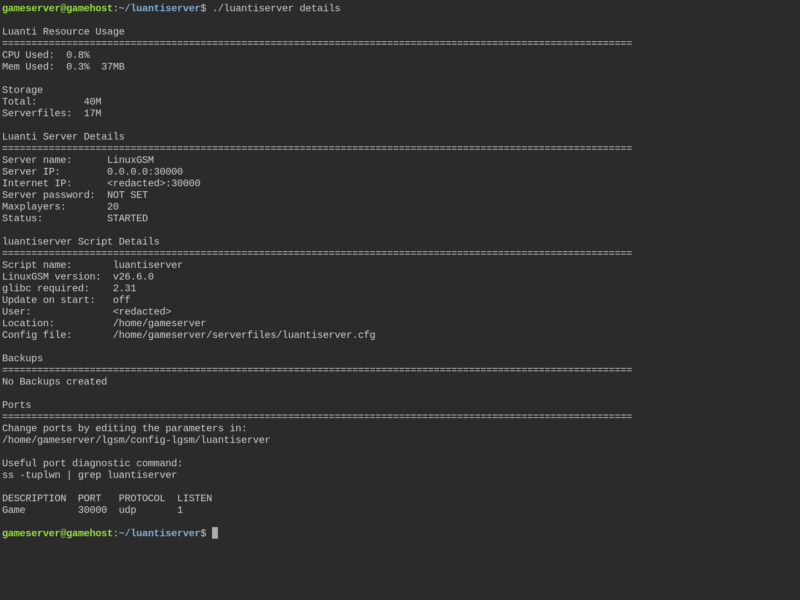
Day to day, the same script is the control surface: start, stop and restart; update; back up; monitor; open the console. The server runs inside a tmux session (a terminal multiplexer), so it survives a closed SSH connection, and the console attaches to that session. Most commands are meant to be scheduled: a monitor job every five minutes checks the process and queries the game port, reboots a server that has stopped answering and sends an alert, while a cron job can check for updates hourly. The details command prints the distribution, resource use, server name and ports, backup state and exact command line. This is a terminal tool, not a web panel: configuration lives in config files and alerts go to chat or email.
Key Features
- One script per server: 148 supported game servers, each with its own script and ports, mixing SteamCMD titles with servers such as Minecraft, TeamSpeak 3 and Factorio.
- Installer and auto-install: the installer creates directories, handles dependencies, downloads files, loads configs and applies fixes; auto-install skips the prompts for automated deployments.
- Server control: start, stop and restart manage the server in a tmux session, and the console attaches to its output to watch errors or type commands.
- Updates: the update command checks for a new build, applies it and restarts a running server; update-on-start and cron jobs cover servers that are offline most of the time.
- Monitoring: monitor checks the process and tmux session, queries the game server, retries for 60 seconds, then reboots and alerts if it still does not answer.
- Backups: backup writes a tar.gz of the installation plus saves and config kept outside it, with count and age limits, and can stop the server or wait until it is empty.
- Alerts: failures can be sent to Discord, Slack, Telegram, Matrix, Rocket.Chat, ntfy, Gotify, Pushover, Pushbullet, IFTTT or email.
- Several servers and boot: run separate installations under separate Linux users, or multiple instances from one installation; systemd units or a cron monitor job start them after a reboot.
Licence
MIT. You can run, modify, redistribute and sell it, provided the copyright and permission notice stay with copies. There is no copyleft obligation and no warranty.