Pelican Panel
- Platform
- Self-hosted Docker Linux Web
- Licence
- AGPL-3.0 Open source
- Website
- pelican.dev/
- Source code
- github.com/pelican/panel
Pelican Panel
Website: pelican.dev
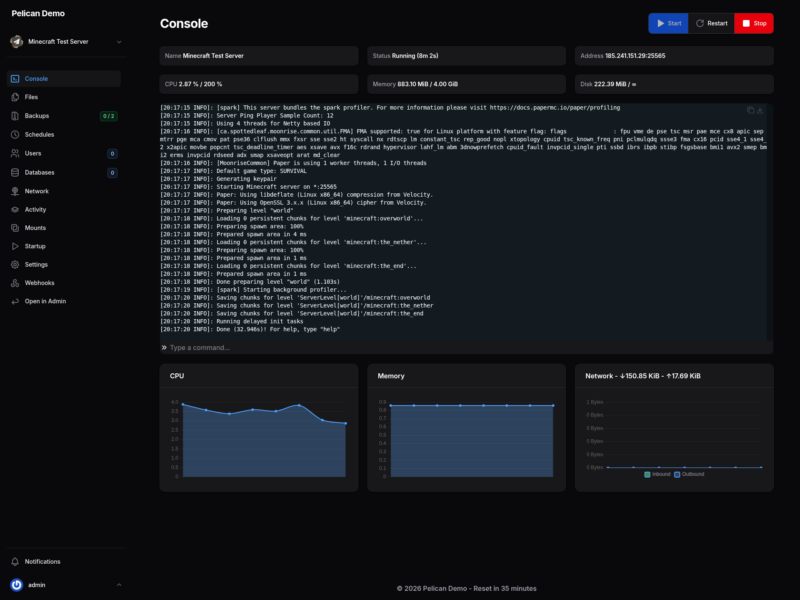
Pelican Panel is a free, open-source control panel for running game servers. It gives players and administrators a web interface for creating servers, watching resource use and managing files, while each server runs in its own Docker container through a companion daemon called Wings. That container boundary is the point: a modded Minecraft server, a SteamCMD title and a database can share a machine without their dependencies colliding.
It began as a fork of Pterodactyl Panel and has since grown into its own project, with a Laravel and Filament interface, a plugin system and a migration path that keeps an existing Pterodactyl install’s servers, users and data. Pelican is the newer fork; Pterodactyl is the original project.
Key Features
- Docker isolation: Wings runs every game server in its own container, so one server’s libraries or runtime cannot break another on the same node.
- Egg templates: Prebuilt install scripts cover Minecraft (Paper, Sponge, BungeeCord, Waterfall), SteamCMD titles such as ARK, Palworld and Project Zomboid, plus standalone games, Discord bots, voice servers and databases.
- Modern interface: The panel is built on Laravel and Filament, with a plugin and theme system fed from the project’s Hub.
- Flexible sign-in: Passkeys, two-factor authentication and OAuth with 11 providers are available for panel accounts.
- Staff permissions: Admin roles and granular permissions let you decide which parts of a server a user or support agent can touch.
- Translations: The interface ships with 32 community-maintained languages.
- Backups: Backups can go to S3 or local storage, configured per node rather than forced panel-wide.
- Install and migrate: Install directly on a Linux server or with Docker; an existing Pterodactyl install can be migrated in place.
Licence
Pelican Panel is released under the GNU Affero General Public License v3.0 (AGPL-3.0), with the Wings daemon under the MIT licence. For self-hosters that means you can run and modify it freely; if you offer a modified version as a network service, the AGPL requires you to publish the source. It is free to use, with no paid tier.