Kinto
- Platform
- Linux macOS Windows Docker
- Licence
- Apache-2.0 Open source
- Website
- kinto-storage.org/
- Source code
- github.com/Kinto/kinto
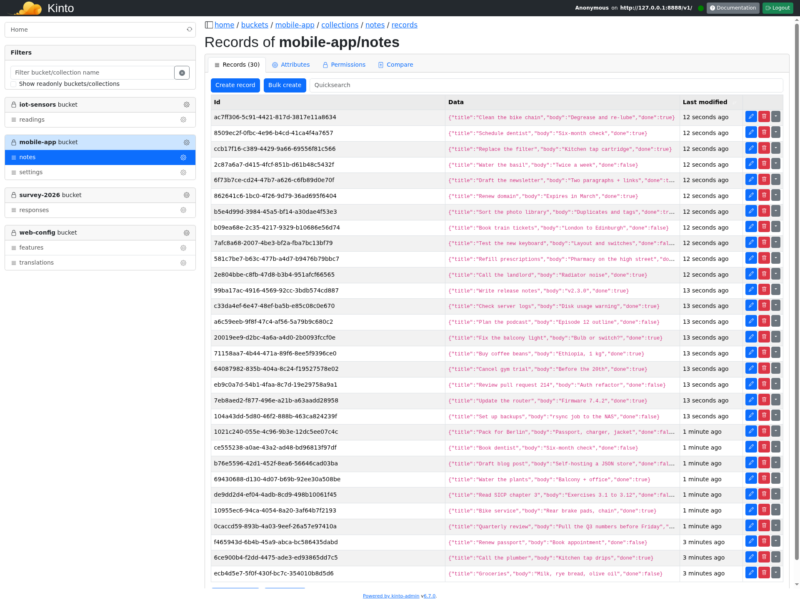
Kinto is a self-hosted JSON document store that speaks plain HTTP. Instead of a database driver, an SDK and a schema migration, an application talks to it with ordinary GET, PUT and POST requests, and data is organised into buckets, collections and records addressed by URL. The project grew out of Mozilla’s need for a sync backend that several applications could share, and its licence file still carries the Mozilla Foundation copyright.
What it does
- Hierarchical JSON storage — a bucket holds collections, a collection holds records, and a record is any JSON object. Everything is addressable and everything is readable over HTTP.
- Synchronisation built in — every object carries an ETag and a modification timestamp, so a client can ask what changed since it last looked and resolve conflicts instead of overwriting a colleague’s edit.
- Fine-grained permissions — read and write permissions are set per bucket, collection or individual record, with groups for shared access. The accounts plugin adds username/password authentication and an administrator account.
- Pluggable backends — an in-memory backend for development and PostgreSQL 9.5+ for production, with optional Redis or memcached for caching.
- Python and Docker packaging —
pip install kintointo a Python 3.11+ environment, or run the officialkinto/kinto-serverimage, which ships the current release (26.6.0) with the admin console included. - kinto-admin — a React console served by the server itself, for browsing buckets and collections, editing records as JSON, inspecting permissions and reviewing history without writing curl commands.
- Client libraries — kinto.js is an offline-first JavaScript client that keeps a local copy and syncs when it can reach the server; anything else can use the HTTP API directly.
- Optional attachments — the kinto-attachment plugin stores files alongside records, so a document and its metadata live in one object.
What people use it for
The project positions Kinto as the backend a front-end developer does not have to build: offline-first applications that keep working without a connection, remote configuration and content delivery pushed from a central place, structured data collection from forms and surveys, and collaborative tools with per-record permissions. Data can also be stored encrypted, with the key held by the user rather than the application.
Requirements
Python 3.11 or newer, or the container image. Production deployments need PostgreSQL 9.5+ and should terminate HTTPS in front of the WSGI application; the development setup can run entirely in memory, which is also why the accounts plugin warns that memory-backed accounts are flushed on every restart. Self-hosting one instance and pointing several applications at it is the design intent — the server is meant to be deployed, secured and scaled once rather than once per app.
Alternatives
- PocketBase — a single-binary backend with SQLite, auth and a dashboard, closer to a batteries-included app server
- Appwrite — a full backend platform with database, storage, functions and auth