rotki
- Platform
- Linux macOS Windows Docker
- Licence
- AGPL-3.0 Open source
- Website
- rotki.com
- Source code
- github.com/rotki/rotki
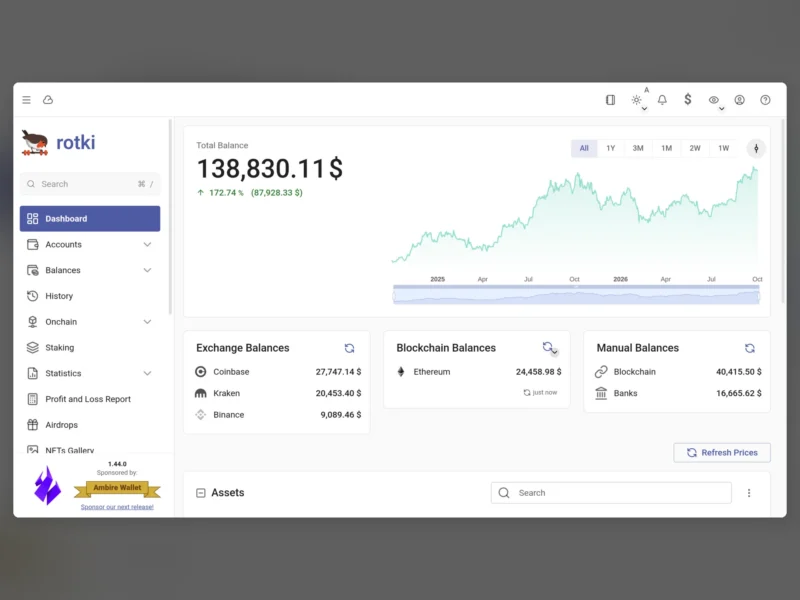
rotki is a desktop portfolio tracker and accounting application for people who hold crypto across exchanges, blockchains and bank accounts and do not want to hand the whole picture to a cloud service. Balances are fetched and stored locally, encrypted with a password only you hold, and the software runs on your own machine. The project describes itself as the open-source, self-hosted portfolio manager, and it is built around the idea that the history behind a number is as valuable as the number itself.
What the dashboard puts in front of you
The dashboard leads with a total balance in your chosen main currency, a change figure, and a chart with switchable windows — everything, one year, three months, one month, two weeks, one week. Beneath it the same balance is broken down by where it lives: exchange balances per venue, blockchain balances per chain, and manual balances for the holdings that no API can see, such as a bank account or a hardware wallet kept offline. A refresh button pulls current prices, and an assets table lists the individual holdings behind the totals.
Tracking and history
- Accounts — connect exchanges read-only by API key, add blockchain addresses, or record manual balances.
- History — transactions and events gathered from those sources and decoded into readable entries rather than raw ledger rows.
- Onchain and staking — sections for chain-level activity and for staking positions, kept apart from exchange trading.
- Statistics and profit and loss — reports built from the recorded history, with accounting settings you can change, and a separate PnL report view.
- NFT gallery — the collectibles held by the tracked addresses, in one place.
Local data and privacy
Nothing is uploaded to a rotki server: the database sits on your disk and is encrypted, so the portfolio history stays with the machine it was recorded on. Exchange and chain data are fetched over read-only connections, which means the software can see balances but cannot move funds. That is the main reason it exists as a desktop application rather than a website.
Platforms and installation
Pre-packaged builds are published for Windows, macOS and Linux — the Linux builds include an AppImage and a Debian package — and the same application is available as a Docker image for running the web interface on a home server. The documented path for most people is the packaged binary; building from source needs Node.js, Python and uv, and is covered separately in the project’s documentation.
Open source with a paid tier
The application itself is released under the GNU Affero General Public License v3.0, with the source on GitHub. A premium subscription adds extra features on top, but the portfolio tracking, history decoding and reports described here are in the open-source build. Development is continuous: release 1.44.3 shipped in November 2026, and the project publishes full changelogs and release notes alongside each version.