DumbBudget
- Platform
- Web Docker
- Licence
- GPL-3.0 Open source
What DumbBudget is
DumbBudget is a personal budget app that tracks income and expenses and tells you the balance, and not much else. It is built by DumbWare.io – the same house that ships DumbAssets – as a single Node.js container with a PIN in front of it and JSON files on disk behind it, published on GitHub under the GNU GPL v3.0.
The name is the specification. There are no bank connections, no envelope budgets, no forecasting and no accounts: you record what came in and what went out, tag each entry with a category, and the app keeps a running total. For a household that wants a private ledger without subscribing to a budgeting service, that is the entire job.
The project is written in JavaScript, has been developed since early 2025, sits at roughly 340 GitHub stars, and keeps pace with its sibling DumbAssets: same layout conventions, same PIN model, same one-directory data store.
Transactions and balances
Entries. Each transaction is a type – income or expense – with an amount, a description, a category and a date. An optional notes field and a recurring flag are there for the ones you enter again every month, and editing or deleting a row is a single action from the list.
Totals. The balance is recalculated from the entries as you add them, so the figure at the top of the screen is income minus expenses for the period you are looking at rather than a number you maintain by hand. Income and expense totals are broken out separately, which makes it obvious when a month is only balanced because of one large one-off payment.
Categories. Categories are free text attached to each transaction, and the list can be filtered by them, so reporting is a matter of narrowing the view rather than exporting to a spreadsheet. Typical sets map to a household: housing, groceries, utilities, transport, health, savings.
Filtering, sorting and export
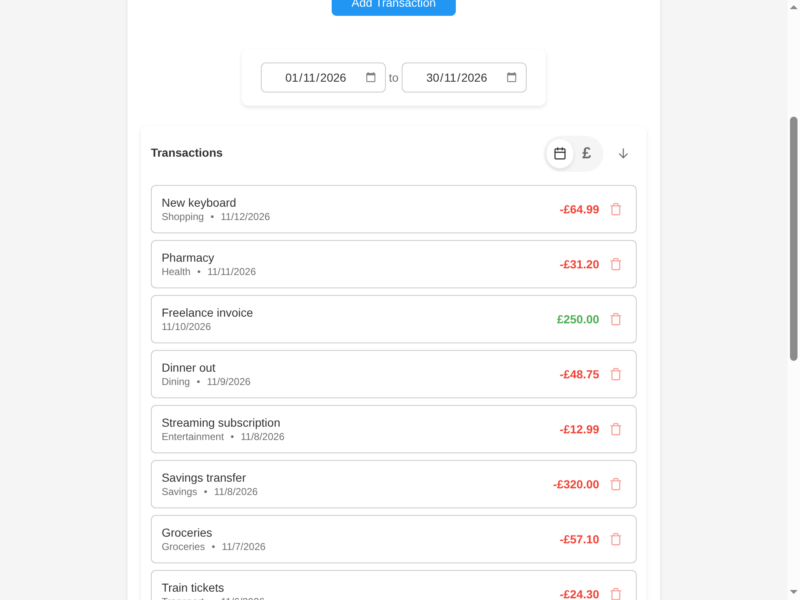
The transaction view is scoped by a date range, defaulting to the current month, with a picker for any other period. Rows sort by date or by amount, and the type filter narrows the list to income or expenses alone. Anything on screen can be exported to CSV for the same period, which is the escape hatch if you want to chart it, hand it to an accountant, or move to a different tool later.
Currency is set once per instance through an environment variable and applied to every amount and total – the project lists two dozen supported codes including GBP, EUR, USD, JPY and the other common ones, so the formatting reads correctly rather than defaulting to dollars.
Interface and multi-currency
The interface is a single responsive column: a balance panel, income and expense cards, the add-transaction button, the date filter and the transaction list. It has light and dark themes with the choice remembered, and it installs as a progressive web app, which is how a budgeting app realistically gets used – opened on a phone right after a purchase rather than at a desk at the end of the month.
Several instances can run side by side against separate data directories, each with its own title and instance name, which is the project’s answer to multi-account budgeting: one container per pot of money instead of an account system inside one.
Access control and data
Access is a PIN rather than a login – set through the DUMBBUDGET_PIN variable, verified in constant time, held in a session cookie, with rate limiting on repeated attempts. There are no user accounts, no roles and no sharing between people. A PIN on a private network is the honest level of security for a single-person ledger, and the project does not pretend otherwise; exposing the container to the internet without an authenticating reverse proxy would be a mistake.
Transactions live in JSON files under the mounted data directory, so a backup is a copy of a directory and a migration is copying it back. There is no database, no schema migration and no daemon beyond the Node process itself. The trade is the usual one: one writer at a time, and no query language if you later want to slice the data in unusual ways.
Deployment
A single container: docker run -d -p 3000:3000 -v /path/to/data:/app/data -e DUMBBUDGET_PIN=12345 -e CURRENCY=GBP dumbwareio/dumbbudget:latest. A Compose file is documented for the same job, along with environment variables for the port, base URL, site title, instance name and allowed origins. The image is published to Docker Hub and built from source in the repository; Node.js is the only requirement if you run it directly.
There is no hosted tier and no sync service. The container and the data directory are the whole system, which also means there is no vendor to phone when the disk fills up.
Where it fits
DumbBudget is the smallest thing on the self-hosted budgeting shelf. Actual Budget is an envelope-budgeting system with device sync and bank import; Firefly III is a double-entry bookkeeping application with rules, budgets and reports; Budget Board aims at monthly spending against savings goals. All three ask you to learn their model of money.
DumbBudget asks you to type in what you spent. If what you wanted was a private ledger with a total at the top, faster to run than a spreadsheet and with no account to create, that is exactly what it is. If you want the app to enforce a budget, plan next year, or reconcile a bank statement automatically, pick one of the three above – the missing machinery is deliberate, not pending.