BudgetBee
- Platform
- Web Docker
- Licence
- MIT Open source
- Source code
- github.com/budgetbee/budgetbee
What BudgetBee is
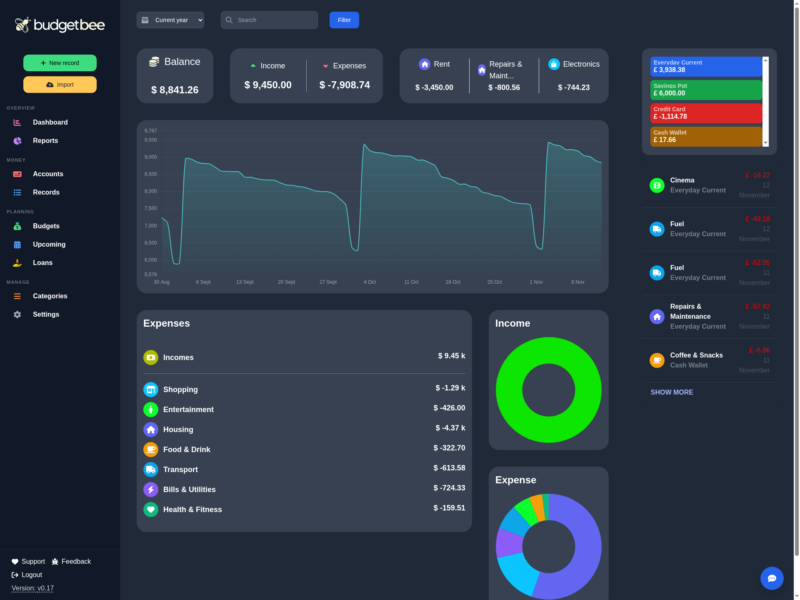
BudgetBee is a self-hosted personal finance manager: transactions, accounts, budgets, upcoming bills and net worth in one interface, running on your own infrastructure rather than in a vendor’s cloud. It is built in JavaScript and PHP – a Laravel backend with a React front end over MySQL or MariaDB – published on GitHub under the MIT licence, and deployed with a single Docker Compose stack.
The pitch is data ownership: your bank history and balances stay in a database you control, and the whole app is one docker-compose away. The project is honest about its stage – it describes itself as under very active development and advises against keeping it as your only financial record until a stable 1.0.0 lands, so it is a tool to evaluate and run alongside your existing records, not to replace them outright.
Tracking money
- Transactions. Record income, expenses and transfers across several accounts, classified with customisable categories and sub-categories.
- Budgets. Set a spending budget per category and watch progress against it in real time, so overspending shows up before the month ends.
- Accounts and net worth. Checking, savings, cash and investment accounts sit side by side, with a total net worth view.
- Upcoming expenses. Recurring and scheduled future bills are tracked so a subscription renewal or a quarterly payment does not arrive unnoticed.
- Reports. Spending patterns, income versus expenses and category breakdowns as interactive charts.
Households, currencies and moving data in
Several people can each have their own account with their own data and settings, which suits a household or a shared flat rather than a single user. Multi-currency support covers accounts held in more than one currency, useful if you travel or are paid in something other than your spending currency. Existing records can be imported from Excel spreadsheets or JSON files, and a REST API with personal API keys allows scripts to read and write the same data.
Running it yourself
The documented deployment is a Docker Compose stack – application container plus a MySQL or MariaDB database – with a GitHub Actions workflow building and publishing the image. Because the project is pre-1.0, take a database backup before pulling a new image: the README warns that breaking changes are expected while the schema settles. There is no hosted option, so the server, the updates and the backups are yours.
Where it fits
BudgetBee is the lightweight end of the self-hosted finance shelf: less accounting machinery than Firefly III, and a smaller feature set than Actual Budget, but a quick way to get a private budget running if you are comfortable with a young project. For a desktop application that keeps everything in a local file, GnuCash remains the conservative choice.