Mindwtr
- Platform
- Linux Windows macOS Android iOS Web
- Licence
- AGPL-3.0 Open source
- Website
- mindwtr.app
- Source code
- github.com/dongdongbh/Mindwtr
What Mindwtr is
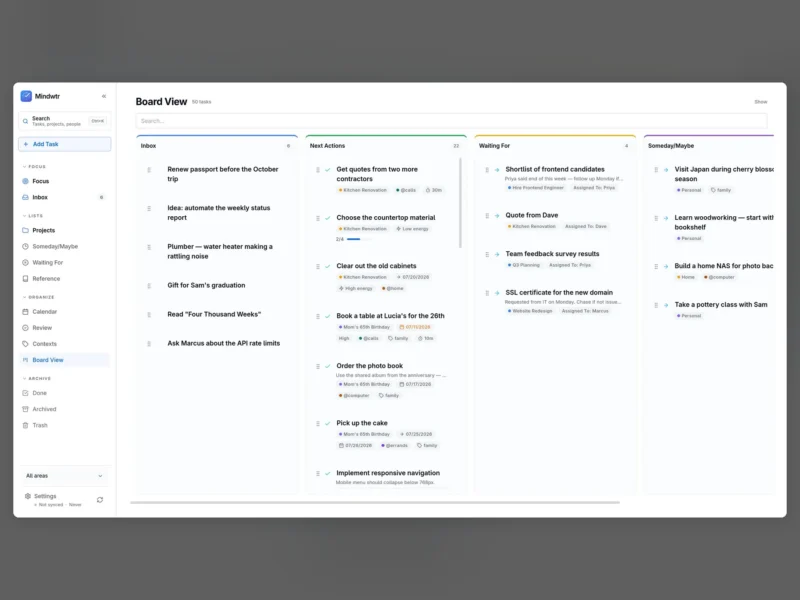
Mindwtr is a to-do app built on Getting Things Done: capture everything in an inbox, decide the next action, park the rest in Waiting For or Someday/Maybe, and review the whole thing weekly. It is a free, open source answer to Everdo and NirvanaHQ, written in TypeScript with a shared core across desktop and mobile, and it runs on Windows, macOS, Linux, iPhone, iPad and Android. The pitch is ownership of the data — tasks sit on the device, the app works offline with no account, and sync is optional and points wherever you choose: iCloud, Dropbox, a shared folder, WebDAV, or a server you run yourself. The README reports 30,000+ users and 23 interface languages, development is active, and the licence is AGPL-3.0.
How people use it
- Capture first, sort later. A desktop shortcut, a phone widget or the share sheet drops anything into the Inbox; the app then guides you through what to do with it, so you do not have to learn GTD before using it.
- The lists the method needs. Next Actions, Waiting For, Someday/Maybe, Reference and a calendar, plus Focus for today’s schedule.
- Doing tasks where you are. Context filters by place and by the tools you have with you, so the list shortens to what is actually possible in the moment.
- A guided weekly review. Projects, waiting items and loose ends are walked through rather than left to memory, which is the part most to-do apps leave out.
- Data that stays yours. Offline by default with backup export; sync is a choice rather than a requirement, and the destination can be a folder, WebDAV, a cloud drive or your own server.
- Bring the old list across. Importers for Todoist, TickTick, OmniFocus and others.
- Extras that stay quiet. Calendar planning, recurring tasks, notes and attachments, with no streaks or productivity scores to keep up. AI assistance is off by default and runs against your own AI account or a model on your machine.
- Automation hooks. A local API and an MCP server let other tools read and change tasks.
Installing it
There is nothing to compile: every platform has prebuilt releases. On Linux it ships through Flathub (tech.dongdongbh.mindwtr), Snap, the AUR and APT/RPM repositories; on Windows through the Microsoft Store, WinGet, Chocolatey and Scoop; on macOS through the App Store and a Homebrew cask; on Android through Play, F-Droid and IzzyOnDroid; on iOS through the App Store. A self-hosted web app and sync server are documented for people who want the data on their own infrastructure — that part is optional and is only needed if you want sync through a machine you control.
Licence
AGPL-3.0. The whole application is free, with no paid tier, account or feature gate; development is funded by sponsors. The licence text is in the repository at LICENSE.
Alternatives
If you want task management that is not tied to the GTD method, the directory’s project and task management category covers the wider field. Super Productivity pairs a task list with timeboxing and time tracking; Vikunja is the self-hosted, list-first option for teams; Focalboard stays closer to a board.